Ch. 4 - Exponential and Logarithmic Functions
Blitzer - College Algebra 8th Edition
Blitzer8th EditionCollege AlgebraISBN: 9780136970514Not the one you use?Change textbook
Chapter 5, Problem 106

In Exercises 105–108, evaluate each expression without using a calculator. log5 (log2 32)

Verified step by step guidance
1
Identify the expression to evaluate: \( \log_5 \left( \log_2 32 \right) \). This means we first need to evaluate the inner logarithm \( \log_2 32 \) before applying the outer logarithm.
Evaluate the inner logarithm \( \log_2 32 \). Recall that \( \log_b a = c \) means \( b^c = a \). So, find the exponent \( c \) such that \( 2^c = 32 \).
Since \( 32 = 2^5 \), it follows that \( \log_2 32 = 5 \). Now substitute this value back into the original expression to get \( \log_5 5 \).
Evaluate the outer logarithm \( \log_5 5 \). Using the definition of logarithms, \( \log_b b = 1 \) for any base \( b > 0 \) and \( b \neq 1 \).
Therefore, \( \log_5 5 = 1 \). This completes the evaluation of the original expression.

Verified video answer for a similar problem:

This video solution was recommended by our tutors as helpful for the problem above.
Video duration:
2m
Was this helpful?

Key Concepts

Here are the essential concepts you must grasp in order to answer the question correctly.

Understanding Logarithms

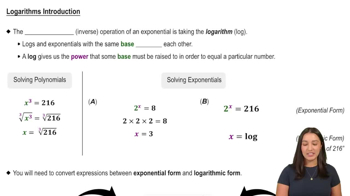
A logarithm answers the question: to what exponent must the base be raised to produce a given number? For example, log_b(a) = c means b^c = a. This concept is fundamental for evaluating and simplifying logarithmic expressions.
Recommended video:
7:30
Logarithms Introduction

Evaluating Inner Logarithmic Expressions

When dealing with nested logarithms like log5(log2 32), first evaluate the inner logarithm. Recognize powers of numbers, such as 32 = 2^5, to simplify log2 32 to 5, which then becomes the argument for the outer logarithm.
Recommended video:
5:14
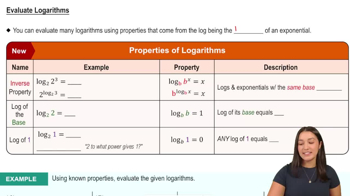
Evaluate Logarithms

Properties of Logarithms and Simplification

Using properties like log_b(b) = 1 helps simplify expressions. After evaluating the inner log, apply these properties to the outer log. This stepwise simplification avoids calculators and relies on understanding logarithmic identities.
Recommended video:
5:36
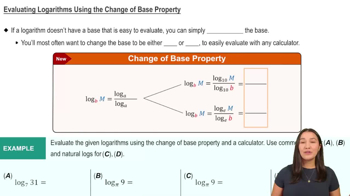
Change of Base Property