Ch. 3 - Polynomial and Rational Functions
Blitzer - College Algebra 8th Edition
Blitzer8th EditionCollege AlgebraISBN: 9780136970514Not the one you use?Change textbook
Chapter 4, Problem 24

Solve each polynomial inequality in Exercises 1–42 and graph the solution set on a real number line. Express each solution set in interval notation. −x2 + 2x ≥ 0

Verified step by step guidance
1
Rewrite the inequality to a standard form: \(-x^2 + 2x \geq 0\).
Factor the left-hand side expression. First, factor out the negative sign: \(-(x^2 - 2x) \geq 0\). Then factor the quadratic inside the parentheses: \(-(x(x - 2)) \geq 0\).
Multiply both sides of the inequality by \(-1\) to remove the negative sign, remembering to reverse the inequality sign because you are multiplying by a negative number: \(x(x - 2) \leq 0\).
Find the critical points by setting each factor equal to zero: \(x = 0\) and \(x - 2 = 0 \Rightarrow x = 2\). These points divide the number line into intervals to test.
Test values from each interval (\((-\infty, 0)\), \((0, 2)\), and \((2, \infty)\)) in the inequality \(x(x - 2) \leq 0\) to determine where the inequality holds true, then express the solution set in interval notation and graph it on the real number line.

Verified video answer for a similar problem:

This video solution was recommended by our tutors as helpful for the problem above.
Video duration:
1m
Was this helpful?

Key Concepts

Here are the essential concepts you must grasp in order to answer the question correctly.

Polynomial Inequalities

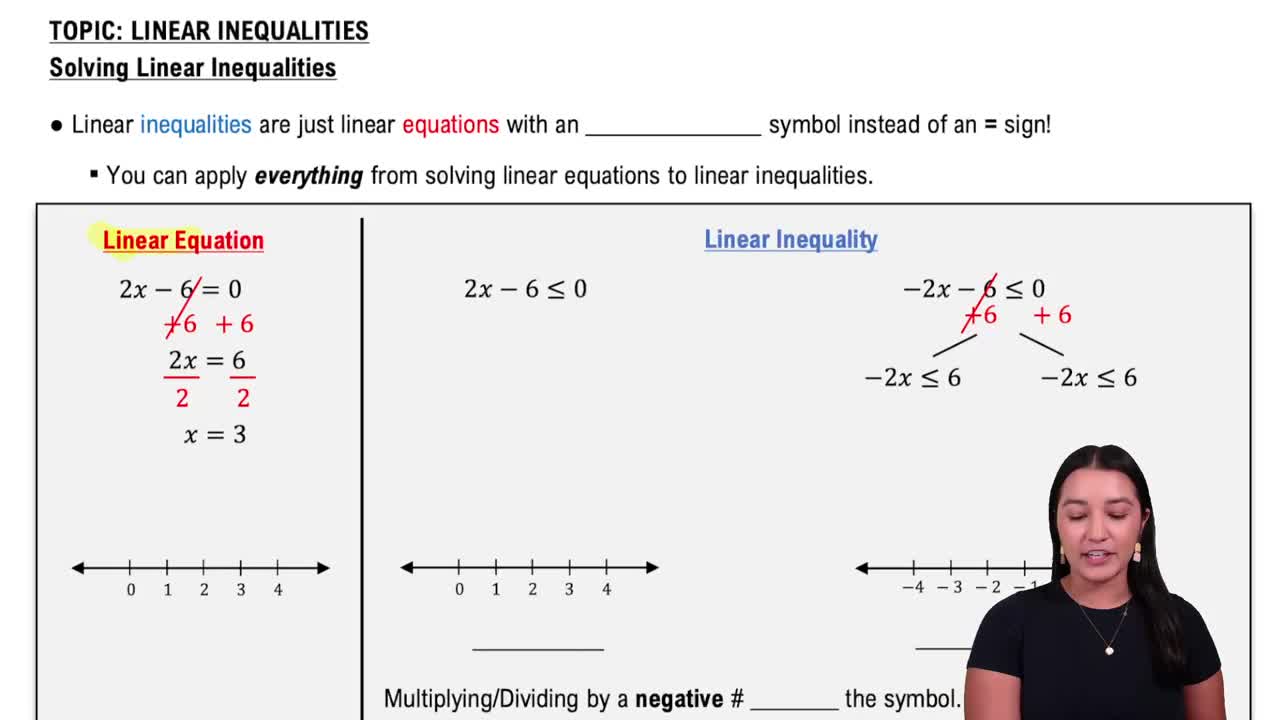
Polynomial inequalities involve expressions where a polynomial is compared to zero or another value using inequality symbols (>, <, ≥, ≤). Solving them requires finding the values of the variable that make the inequality true, often by analyzing the sign of the polynomial over different intervals.
Recommended video:
06:07
Linear Inequalities

Factoring Quadratic Expressions

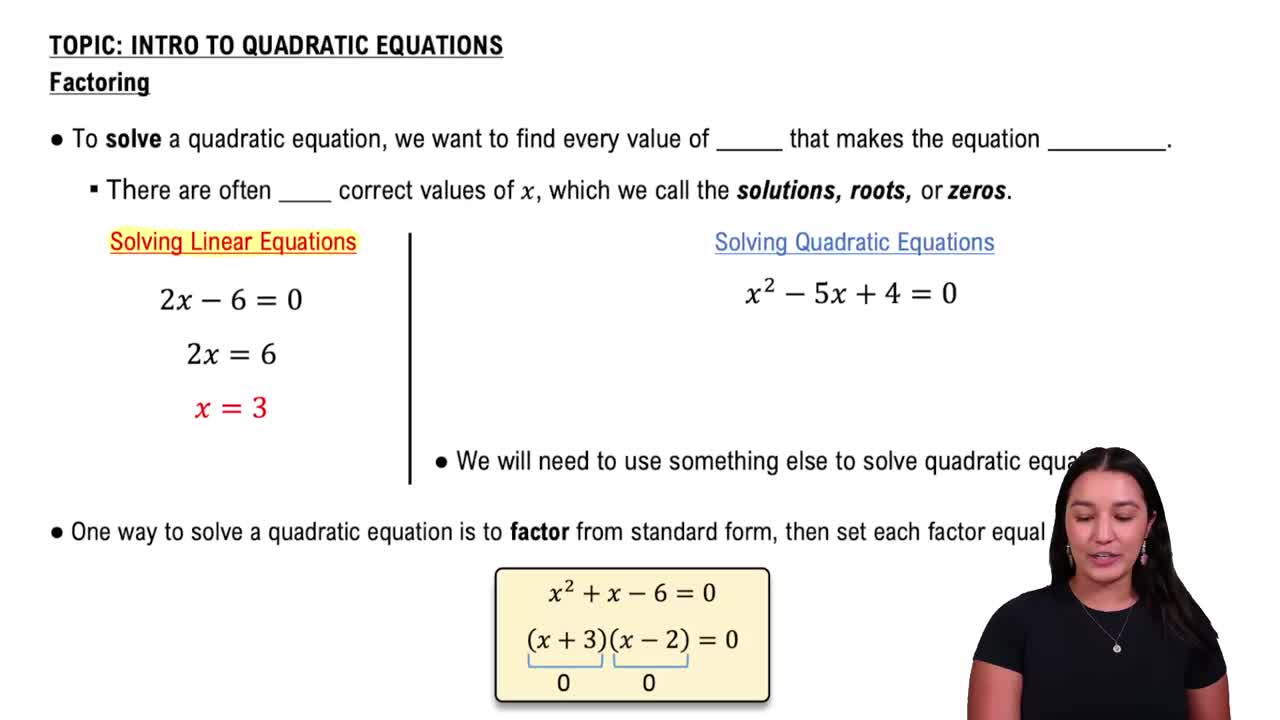
Factoring is the process of rewriting a quadratic polynomial as a product of simpler polynomials. This helps identify the roots or zeros of the quadratic, which are critical points where the expression changes sign, aiding in solving inequalities.
Recommended video:
06:08
Solving Quadratic Equations by Factoring

Interval Notation and Number Line Graphing

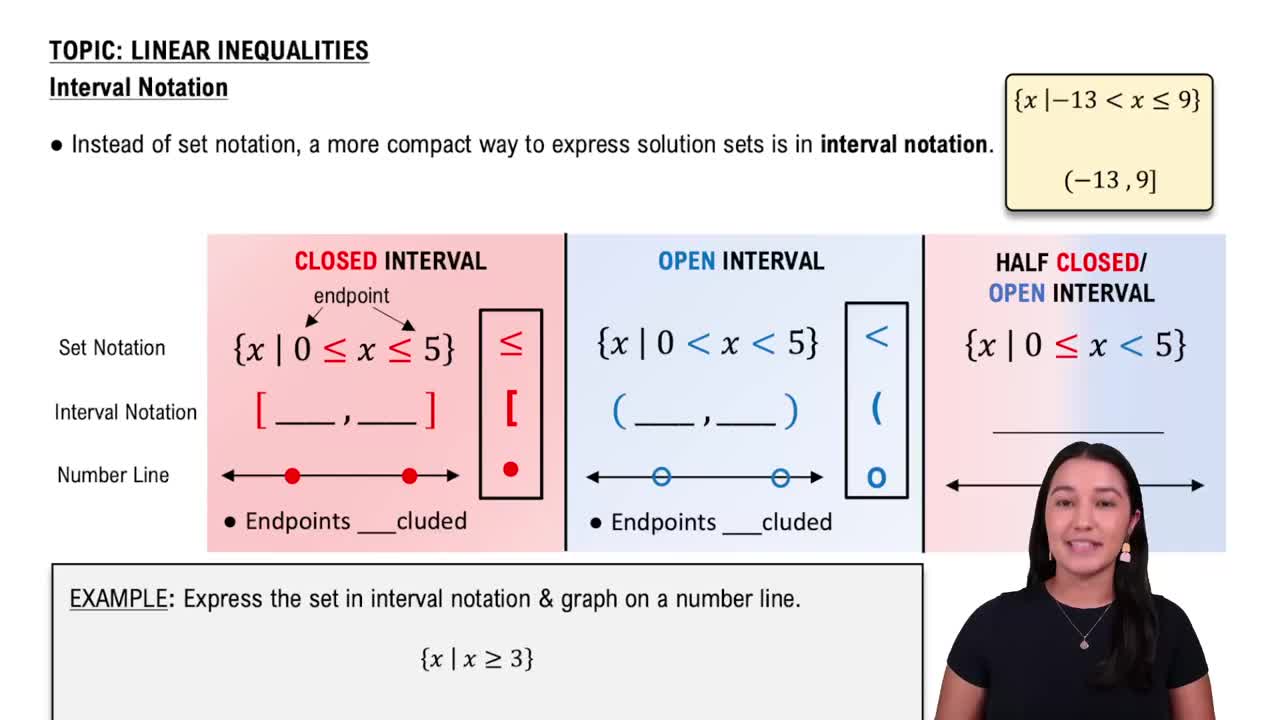
Interval notation is a concise way to represent sets of real numbers, especially solution sets of inequalities. Graphing on a number line visually shows where the polynomial inequality holds true, using open or closed dots to indicate whether endpoints are included.
Recommended video:
05:18
Interval Notation