Ch. 3 - Polynomial and Rational Functions
Blitzer - College Algebra 8th Edition
Blitzer8th EditionCollege AlgebraISBN: 9780136970514Not the one you use?Change textbook
Chapter 4, Problem 65

Solve each inequality in Exercises 65–70 and graph the solution set on a real number line. |x2 + 2x - 36| > 12

Verified step by step guidance
1
Start by understanding that the inequality involves an absolute value: \(|x^{2} + 2x - 36| > 12\). This means the expression inside the absolute value is either greater than 12 or less than -12.
Set up two separate inequalities to remove the absolute value: \(x^{2} + 2x - 36 > 12\) and \(x^{2} + 2x - 36 < -12\).
Simplify each inequality by moving all terms to one side: For the first, \(x^{2} + 2x - 36 - 12 > 0\) which simplifies to \(x^{2} + 2x - 48 > 0\). For the second, \(x^{2} + 2x - 36 + 12 < 0\) which simplifies to \(x^{2} + 2x - 24 < 0\).
Solve each quadratic inequality separately by first finding the roots of the corresponding quadratic equations \(x^{2} + 2x - 48 = 0\) and \(x^{2} + 2x - 24 = 0\) using the quadratic formula: \(x = \frac{-b \pm \sqrt{b^{2} - 4ac}}{2a}\) where \(a=1\), \(b=2\), and \(c\) is either \(-48\) or \(-24\).
Use the roots to determine the intervals where each quadratic expression is positive or negative. Then combine the solution sets from both inequalities to find the overall solution to the original absolute value inequality. Finally, graph these intervals on the real number line.

Verified video answer for a similar problem:

This video solution was recommended by our tutors as helpful for the problem above.
Video duration:
12m
Was this helpful?

Key Concepts

Here are the essential concepts you must grasp in order to answer the question correctly.

Absolute Value Inequalities

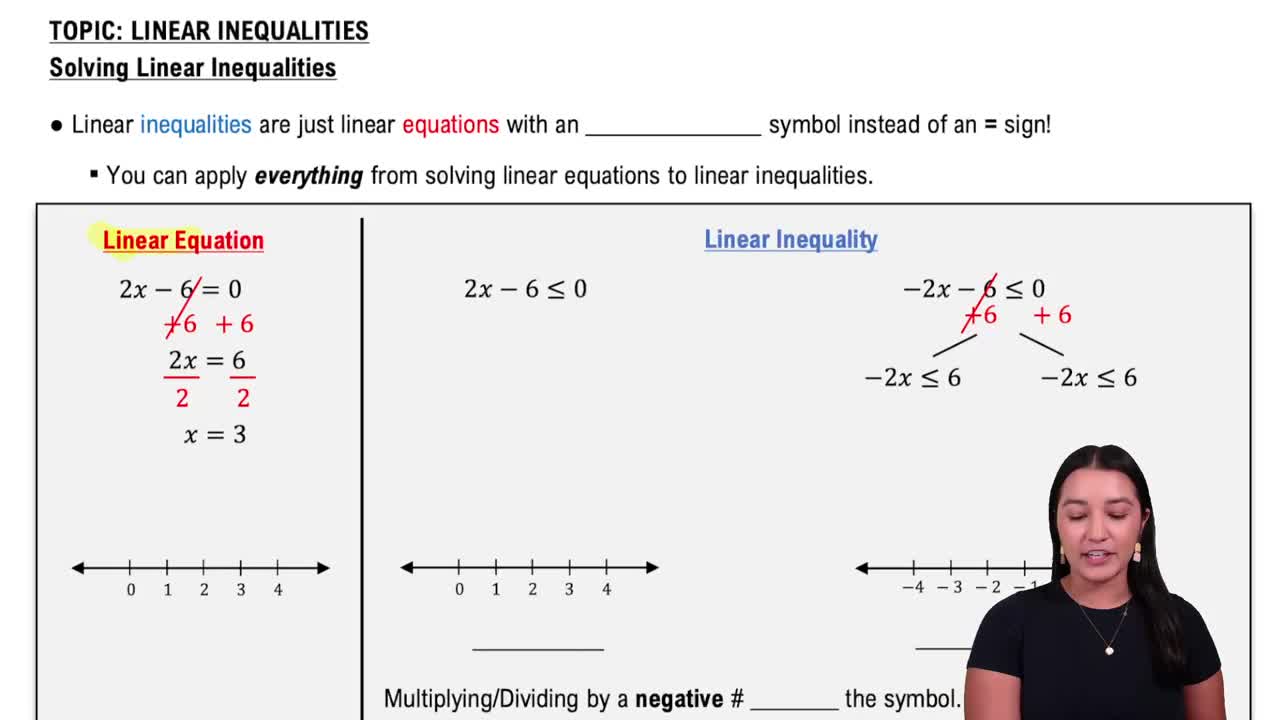
Absolute value inequalities involve expressions where the absolute value of an expression is compared to a number. To solve |A| > B, where B > 0, split it into two inequalities: A > B or A < -B. This approach helps handle the distance interpretation of absolute values on the number line.
Recommended video:
06:07
Linear Inequalities

Quadratic Expressions and Factoring

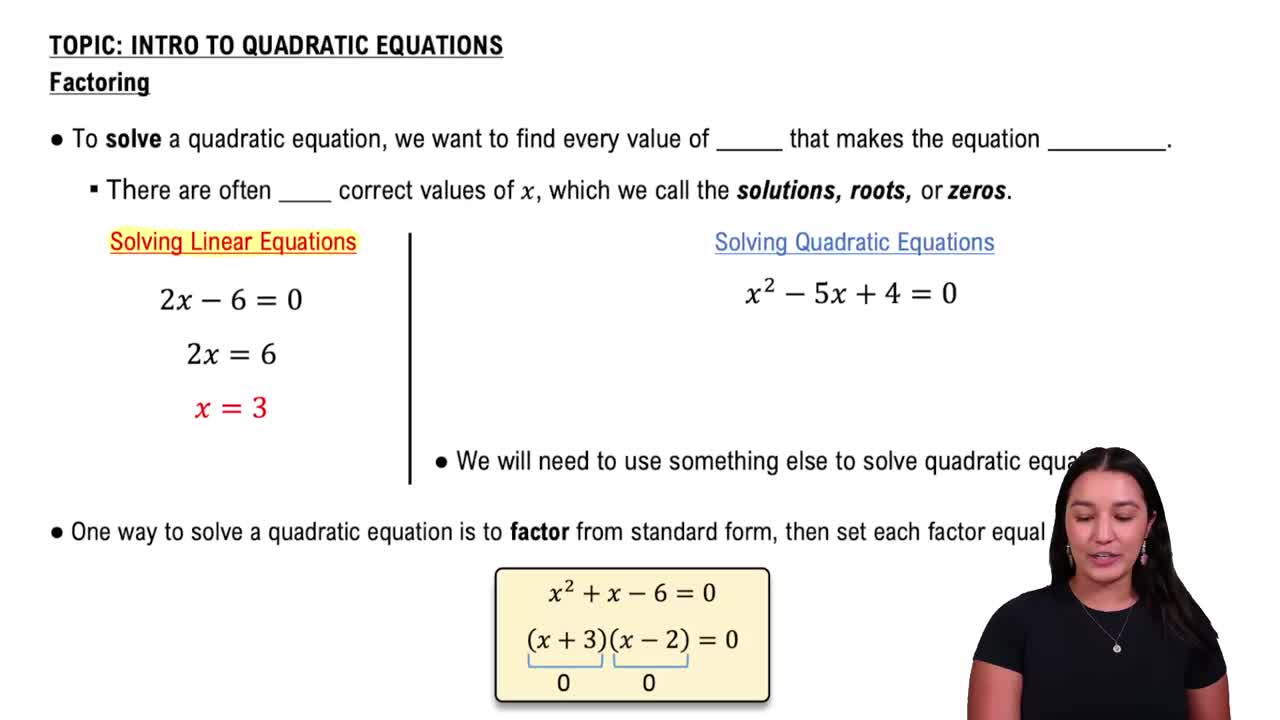
Quadratic expressions are polynomials of degree two, often written as ax² + bx + c. Factoring these expressions into products of binomials helps find their roots, which are critical for solving inequalities and determining intervals for testing solutions.
Recommended video:
06:08
Solving Quadratic Equations by Factoring

Graphing Solution Sets on the Real Number Line

Graphing solution sets involves representing the values that satisfy an inequality on a number line. After solving, intervals where the inequality holds true are marked, often using open or closed circles to indicate whether endpoints are included, providing a visual understanding of the solution.
Recommended video:
Guided course
02:35
Graphing Lines in Slope-Intercept Form