Ch. 4 - Exponential and Logarithmic Functions
Blitzer - College Algebra 8th Edition
Blitzer8th EditionCollege AlgebraISBN: 9780136970514Not the one you use?Change textbook
Chapter 5, Problem 96

In Exercises 89–102, determine whether each equation is true or false. Where possible, show work to support your conclusion. If the statement is false, make the necessary change(s) to produce a true statement. ln x + ln(2x) = ln(3x)

Verified step by step guidance
1
Recall the logarithm property that states: lna + lnb = ln(a × b). This means we can combine the left side of the equation by multiplying the arguments inside the logarithms.
Apply this property to the left side: ln x + ln(2x) = ln(x imes 2x) = ln(2x^2).
Rewrite the original equation using this simplification: ln(2x^2) = ln(3x).
Since the natural logarithm function is one-to-one, the equation ln(A) = ln(B) implies A = B. Therefore, set the arguments equal: 2x^2 = 3x.
Solve the equation 2x^2 = 3x by bringing all terms to one side: 2x^2 - 3x = 0. Factor out x: x(2x - 3) = 0. This gives solutions x = 0 or x = rac{3}{2}. Since ln x is undefined for x \(\leq\) 0, discard x = 0. So, the only valid solution is x = rac{3}{2}. This means the original equation is not true for all x, only for this specific value.

Verified video answer for a similar problem:

This video solution was recommended by our tutors as helpful for the problem above.
Video duration:
3m
Was this helpful?

Key Concepts

Here are the essential concepts you must grasp in order to answer the question correctly.

Properties of Logarithms

Logarithms have specific properties that simplify expressions, such as the product rule: ln(a) + ln(b) = ln(ab). Understanding these rules allows you to combine or break down logarithmic expressions correctly.
Recommended video:
5:36
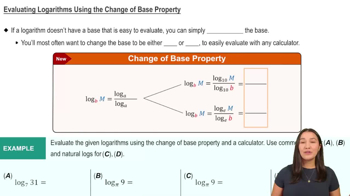
Change of Base Property

Domain of Logarithmic Functions

The domain of ln(x) is x > 0, meaning the argument inside the logarithm must be positive. When solving or verifying logarithmic equations, ensure all values satisfy this domain restriction to avoid invalid solutions.
Recommended video:
5:26
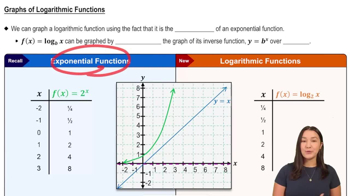
Graphs of Logarithmic Functions

Equation Verification and Manipulation

To determine if an equation is true, substitute and simplify both sides using algebraic and logarithmic rules. If false, adjust terms logically to form a valid equation, ensuring consistency with logarithmic properties and domain constraints.
Recommended video:
06:00
Categorizing Linear Equations