Determine the values of the variable that cannot possibly be solutions of each equation. Do not solve. 1/(4x) - 2/x = 3
Verified step by step guidance
1
Identify the denominators in the equation: the denominators are \$4x\( and \)x$.
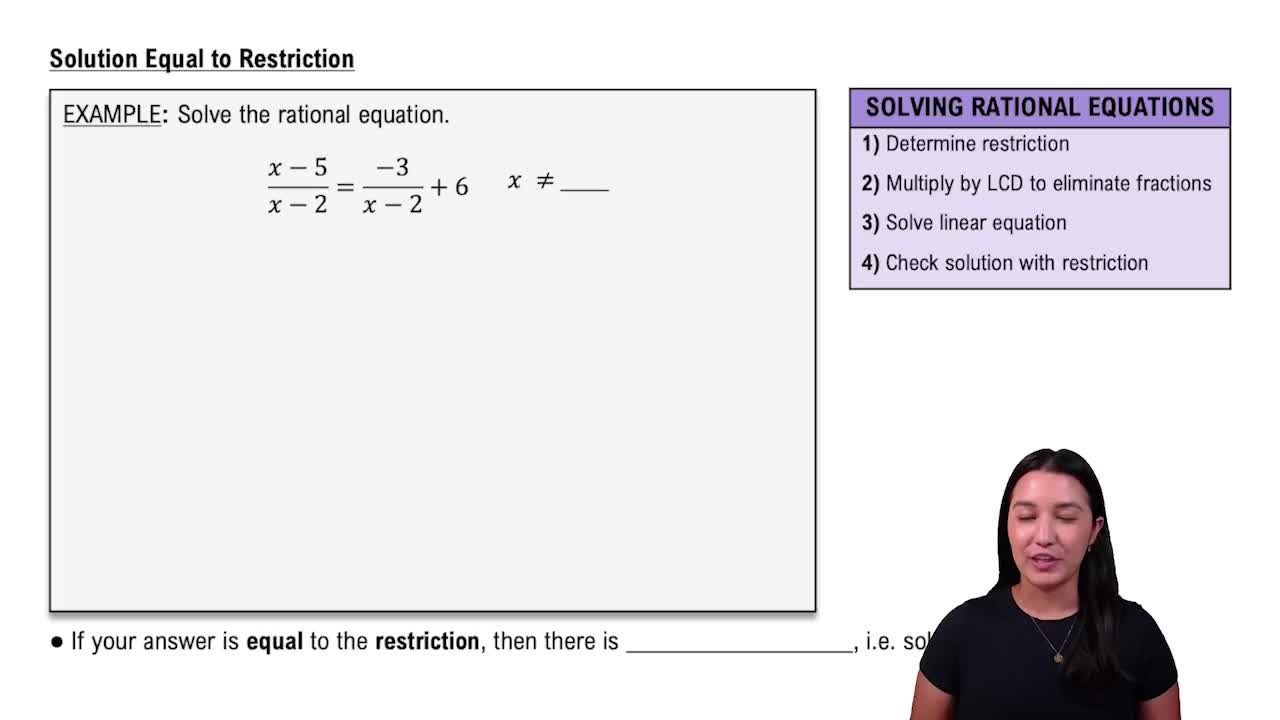
Recall that division by zero is undefined, so the values of \(x\) that make any denominator zero cannot be solutions.
Set each denominator equal to zero and solve for \(x\): For \$4x = 0\(, solve \)4x = 0\( which gives \)x = 0\(; for \)x = 0\(, it is already clear that \)x = 0$ is not allowed.
Conclude that \(x = 0\) is the value that cannot possibly be a solution because it makes the denominators zero.
No other values are excluded since these are the only denominators in the equation.
Verified video answer for a similar problem:
This video solution was recommended by our tutors as helpful for the problem above
Video duration:
1m
Play a video:
0 Comments
Key Concepts
Here are the essential concepts you must grasp in order to answer the question correctly.
Domain Restrictions in Rational Expressions
Rational expressions involve variables in denominators, which cannot be zero because division by zero is undefined. Identifying values that make any denominator zero is essential to determine which values are excluded from the solution set.
Before solving or analyzing rational equations, it is important to simplify expressions by finding common denominators or factoring. This helps in clearly identifying restrictions and understanding the structure of the equation.
Values that make denominators zero are not solutions and must be excluded from the solution set. Distinguishing these from actual solutions ensures correct interpretation of the equation without attempting to solve for invalid values.