Distribute the fraction \( \frac{1}{5} \) to \( 5x \). This means multiplying \( \frac{1}{5} \times 5x \), which simplifies to \( x \).
Simplify the expression inside the brackets \( (3y) + (-3y) \). Since \( 3y - 3y = 0 \), the entire bracket simplifies to \( 0 \).
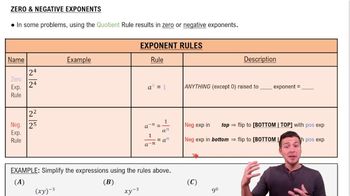
Handle the subtraction of \( -x \). Subtracting \( -x \) is equivalent to adding \( x \), so \( -(-x) = x \).
Combine all simplified terms: \( x + 0 + x \).
Add the like terms \( x + x \) to further simplify the expression.
Verified video answer for a similar problem:
This video solution was recommended by our tutors as helpful for the problem above
Video duration:
4m
Play a video:
0 Comments
Key Concepts
Here are the essential concepts you must grasp in order to answer the question correctly.
Distributive Property
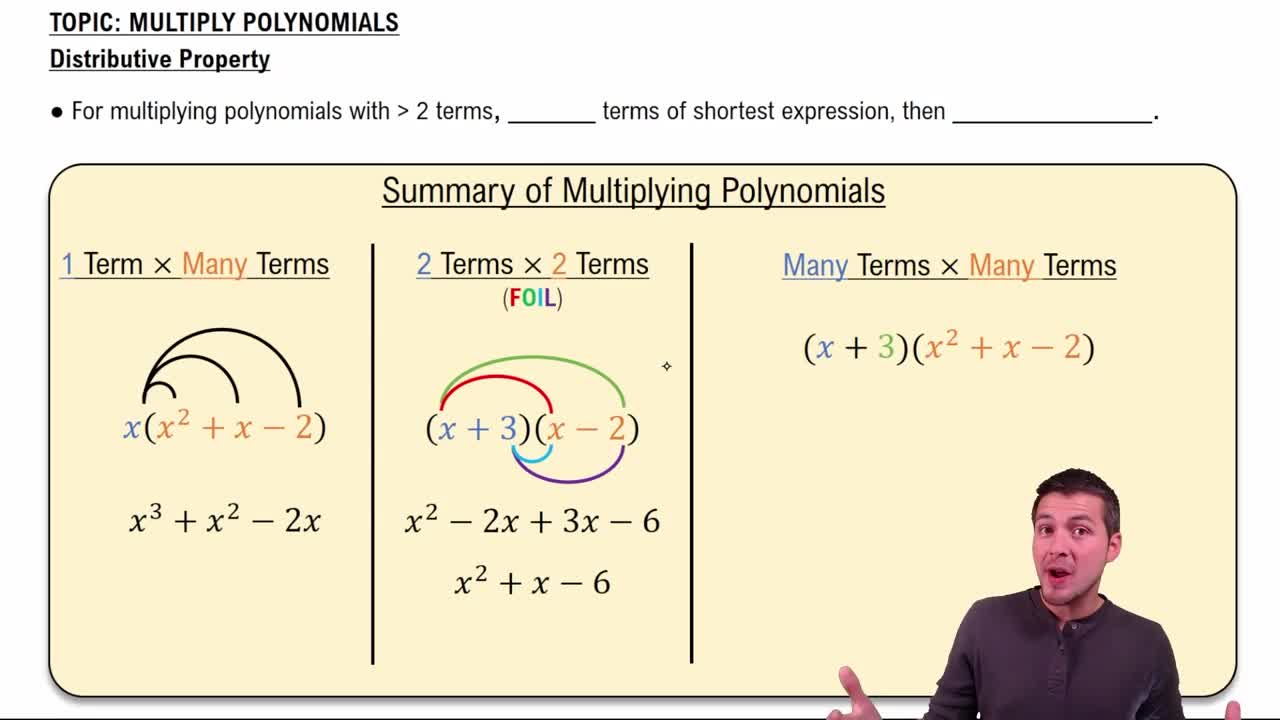
The Distributive Property states that a(b + c) = ab + ac. This property allows us to multiply a single term by each term within a set of parentheses, which is essential for simplifying expressions. In the given expression, applying this property helps in distributing the coefficient (1/5) to the term (5x).
Multiply Polynomials Using the Distributive Property
Combining Like Terms
Combining like terms involves adding or subtracting terms that have the same variable raised to the same power. In the expression, (3y) and (-3y) are like terms that cancel each other out, simplifying the expression significantly. This concept is crucial for reducing expressions to their simplest form.
Understanding negative signs is vital in algebra, as they can change the value of terms. In the expression, the term -(-x) simplifies to +x, demonstrating how two negative signs result in a positive. This concept is important for correctly interpreting and simplifying expressions involving negative values.

 4:20 minutes
 Verified step by step guidance
 04:15
04:15