In Exercises 9–16, a) List all possible rational zeros. b) Use synthetic division to test the possible rational zeros and find an actual zero. c) Use the quotient from part (b) to find the remaining zeros of the polynomial function. f(x)=2x3−3x2−11x+6
Ch. 3 - Polynomial and Rational Functions

Chapter 4, Problem 12
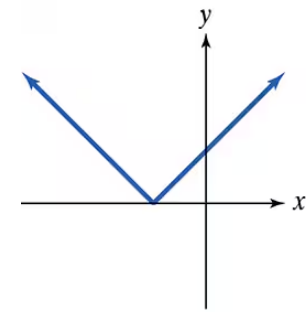
Identify which graphs are not those of polynomial functions.

Verified step by step guidance1
Step 1: Observe the shape of the graph. The graph shows a V-shaped function with two straight lines meeting at the origin (0,0).
Step 2: Recall that polynomial functions are smooth and continuous with no sharp corners or cusps. Their graphs are made up of curves, not sharp angles.
Step 3: Notice that the graph has a sharp corner at the origin, which indicates a cusp or a point where the function is not differentiable.
Step 4: Recognize that this V-shaped graph resembles the absolute value function, which is defined as \(y = |x|\), and is not a polynomial because it involves an absolute value operation.
Step 5: Conclude that since the graph has a sharp corner and is not smooth, it is not the graph of a polynomial function.

Verified video answer for a similar problem:
This video solution was recommended by our tutors as helpful for the problem above.
Video duration:
48sWas this helpful?
Key Concepts
Here are the essential concepts you must grasp in order to answer the question correctly.
Polynomial Functions
Polynomial functions are algebraic expressions consisting of variables raised to non-negative integer powers with constant coefficients. Their graphs are smooth and continuous curves without sharp corners or cusps, and they can have turning points but no abrupt changes in direction.
Recommended video:
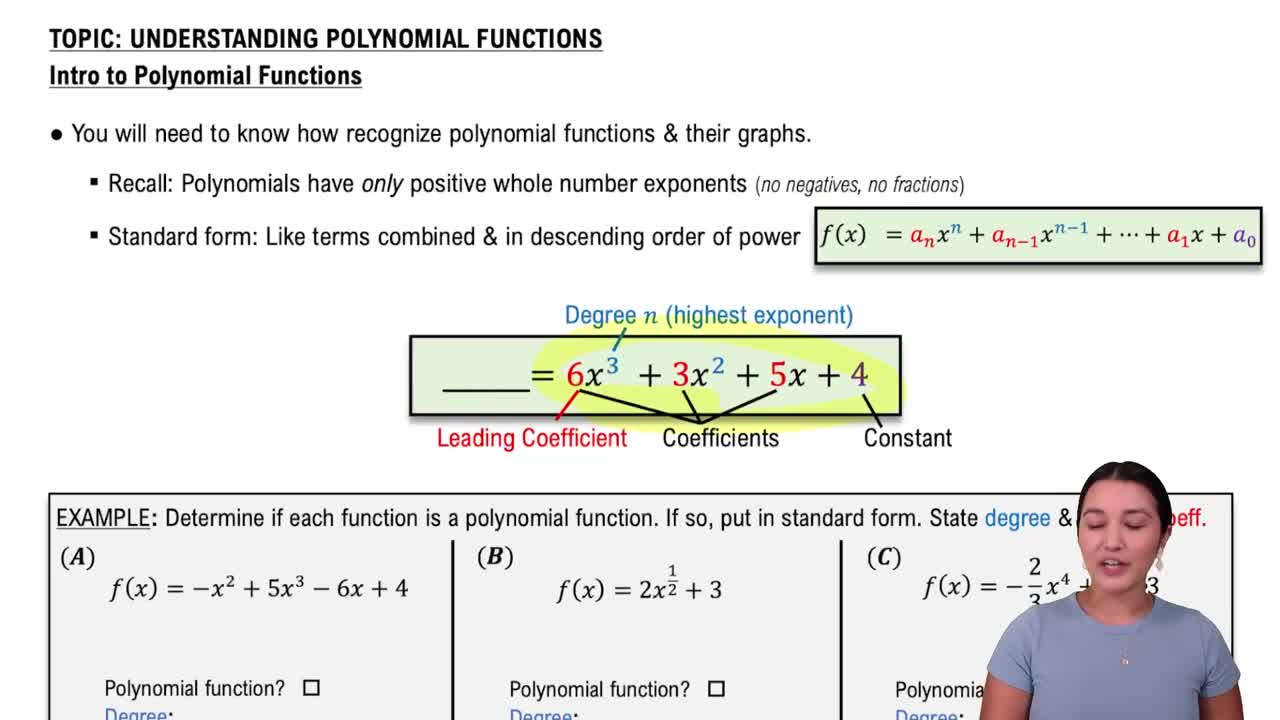
Introduction to Polynomial Functions
Graph Characteristics of Polynomial Functions
The graphs of polynomial functions are continuous and differentiable everywhere, meaning they have no sharp points or corners. They typically exhibit smooth curves, and their end behavior depends on the leading term's degree and coefficient.
Recommended video:
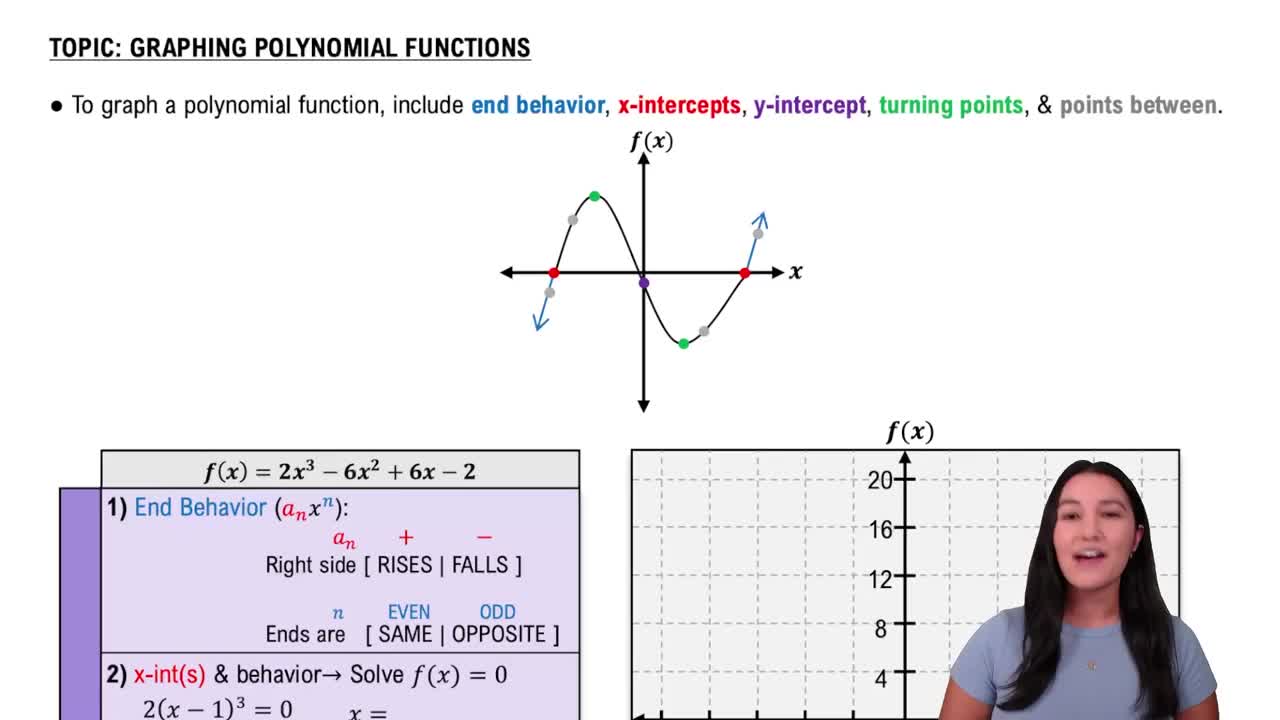
Graphing Polynomial Functions
Non-Polynomial Graphs and Sharp Corners
Graphs with sharp corners or 'V' shapes, like the absolute value function, are not polynomial functions because polynomials are differentiable everywhere. Such graphs indicate piecewise or non-polynomial functions, which have points where the derivative does not exist.
Recommended video:
Graphing Polynomial Functions
Related Practice
Textbook Question
449
views
Textbook Question
Use the graph of the rational function in the figure shown to complete each statement in Exercises 9–14.
As _____
1390
views
1
rank
Textbook Question
Divide using long division. State the quotient, and the remainder, r(x). (x4−81)/(x−3)
549
views
Textbook Question
Identify which graphs are not those of polynomial functions.
1037
views
Textbook Question
Solve each polynomial inequality in Exercises 1–42 and graph the solution set on a real number line. Express each solution set in interval notation. 9x2+3x−2≥0
374
views
Textbook Question
In Exercises 9–16, a) List all possible rational zeros. b) Use synthetic division to test the possible rational zeros and find an actual zero. c) Use the quotient from part (b) to find the remaining zeros of the polynomial function.
442
views
