Write the augmented matrix for each system and give its dimension. Do not solve. 2x + y + z - 3 = 0 3x - 4y + 2z + 7 = 0 x + y + z - 2 = 0
Verified step by step guidance
1
Rewrite each equation in the system so that all variables and constants are on the same side, isolating the constant term on the right side. For example, rewrite the first equation as \$2x + y + z = 3$.
Identify the coefficients of each variable in each equation and the constants on the right side. For the system, the coefficients form the matrix part, and the constants form the augmented column.
Construct the augmented matrix by placing the coefficients of \(x\), \(y\), and \(z\) in rows corresponding to each equation, and append the constants as the last column. The matrix will look like this:
\[\left[\begin{array}{ccc|c} 2 & 1 & 1 & 3 \\ 3 & -4 & 2 & -7 \\ 1 & 1 & 1 & 2 \end{array}\right]\]
Determine the dimension of the augmented matrix by counting the number of rows and columns. The number of rows corresponds to the number of equations, and the number of columns corresponds to the number of variables plus one (for the augmented part).
Summarize the dimension as \(m \times n\), where \(m\) is the number of equations (rows) and \(n\) is the number of variables plus one (columns). In this case, it will be \(3 \times 4\).
Verified video answer for a similar problem:
This video solution was recommended by our tutors as helpful for the problem above
Video duration:
4m
Play a video:
0 Comments
Key Concepts
Here are the essential concepts you must grasp in order to answer the question correctly.
Augmented Matrix
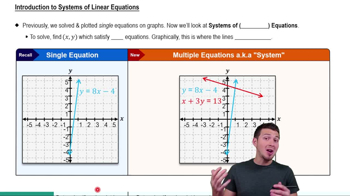
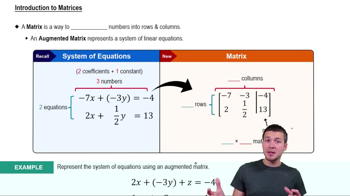
An augmented matrix represents a system of linear equations by combining the coefficient matrix and the constants into one matrix. Each row corresponds to an equation, and each column corresponds to a variable or the constants. This form is useful for applying matrix operations to solve or analyze the system.
The dimension of a matrix is given by the number of rows and columns it contains, expressed as 'rows × columns'. For an augmented matrix, the rows equal the number of equations, and the columns equal the number of variables plus one for the constants. Understanding dimensions helps in matrix operations and system analysis.
A system of linear equations consists of multiple linear equations involving the same set of variables. Each equation represents a linear relationship, and the system can be represented in matrix form. Recognizing the structure of such systems is essential for forming the augmented matrix correctly.