In Exercises 81–88, a. Find the slant asymptote of the graph of each rational function and b. Follow the seven-step strategy and use the slant asymptote to graph each rational function. f(x)=(x2+x−6)/(x−3)
Ch. 3 - Polynomial and Rational Functions

Chapter 4, Problem 87
Solve each inequality in Exercises 86–91 using a graphing utility. 2x2 + 5x - 3 ≤ 0
Verified step by step guidance1
Identify the inequality to solve: \(2x^{2} + 5x - 3 \leq 0\).
Rewrite the inequality as an equation to find critical points: \$2x^{2} + 5x - 3 = 0$.
Use the quadratic formula to solve for \(x\): \(x = \frac{-b \pm \sqrt{b^{2} - 4ac}}{2a}\), where \(a=2\), \(b=5\), and \(c=-3\).
Calculate the roots from the quadratic formula; these roots divide the number line into intervals to test for the inequality.
Use a graphing utility to plot \(y = 2x^{2} + 5x - 3\) and determine where the graph lies on or below the \(x\)-axis (i.e., where \(y \leq 0\)) to find the solution intervals.

Verified video answer for a similar problem:
This video solution was recommended by our tutors as helpful for the problem above.
Video duration:
1mWas this helpful?
Key Concepts
Here are the essential concepts you must grasp in order to answer the question correctly.
Quadratic Inequalities
A quadratic inequality involves a quadratic expression set less than, greater than, or equal to zero. Solving it requires finding the range of x-values where the quadratic expression satisfies the inequality, often by analyzing the parabola's position relative to the x-axis.
Recommended video:
Guided course
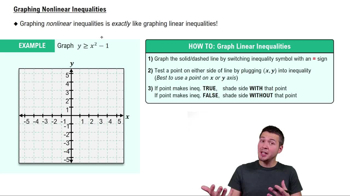
Nonlinear Inequalities
Graphing Quadratic Functions
Graphing a quadratic function y = ax² + bx + c produces a parabola. The graph helps visualize where the function is above or below the x-axis, which corresponds to positive or negative values of the quadratic expression, aiding in solving inequalities.
Recommended video:
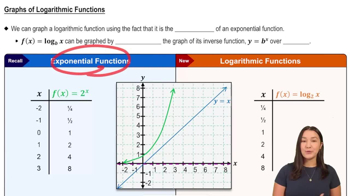
Graphs of Logarithmic Functions
Using Graphing Utilities
Graphing utilities, such as graphing calculators or software, allow quick plotting of functions to identify roots and intervals where inequalities hold. They provide a visual method to solve quadratic inequalities by showing where the graph lies relative to the x-axis.
Recommended video:
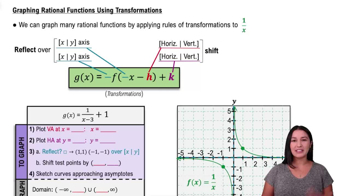
Graphing Rational Functions Using Transformations
Related Practice
Textbook Question
629
views
Textbook Question
Exercises 82–84 will help you prepare for the material covered in the next section. Let f(x)=an(x4−3x2−4). If f(3)=−150, determine the value of a_n.
370
views
Textbook Question
Solve each inequality in Exercises 86–91 using a graphing utility. (x - 4)/(x - 1) ≤ 0
495
views
Textbook Question
In Exercises 81–88, a. Find the slant asymptote of the graph of each rational function and b. Follow the seven-step strategy and use the slant asymptote to graph each rational function. f(x)=(x3+1)/(x2+2x)
601
views
Textbook Question
Solve each inequality in Exercises 86–91 using a graphing utility. x2 + 3x - 10 > 0
573
views
Textbook Question
Solve each inequality in Exercises 86–91 using a graphing utility. x3 + x2 - 4x - 4 > 0
548
views