Ch. 4 - Exponential and Logarithmic Functions
Blitzer - College Algebra 8th Edition
Blitzer8th EditionCollege AlgebraISBN: 9780136970514Not the one you use?Change textbook
Chapter 5, Problem 3

In Exercises 1–10, approximate each number using a calculator. Round your answer to three decimal places. 3√5

Verified step by step guidance
1
Identify the expression to approximate: \(3^{\sqrt{5}}\) means 3 raised to the power of the square root of 5.
Calculate the square root of 5 using a calculator: find \(\sqrt{5}\).
Use the value of \(\sqrt{5}\) as the exponent and calculate \(3^{\text{(value of } \sqrt{5} \text{)}}\) using the calculator's exponentiation function.
Round the result to three decimal places as requested.
Write the final rounded value as the approximate answer.

Verified video answer for a similar problem:

This video solution was recommended by our tutors as helpful for the problem above.
Video duration:
45s
Was this helpful?

Key Concepts

Here are the essential concepts you must grasp in order to answer the question correctly.

Exponents and Radicals

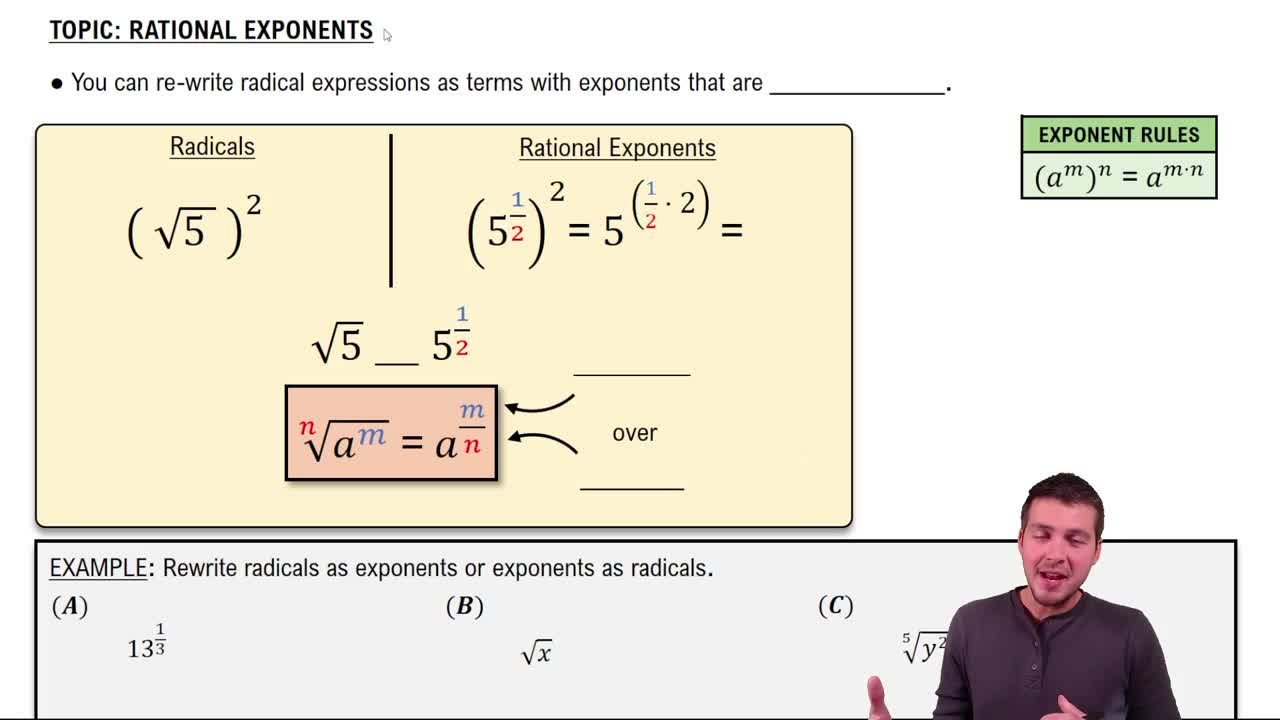
Exponents represent repeated multiplication, while radicals are the inverse operation, indicating roots. Understanding how to interpret expressions like 3 raised to the root of 5 is essential for evaluating such expressions accurately.
Recommended video:
Guided course
04:06
Rational Exponents

Using a Calculator for Approximation

Calculators can approximate values of expressions involving irrational numbers or roots. Knowing how to input roots and exponents correctly ensures accurate results, especially when exact values are not easily simplified.
Recommended video:
5:47
Solving Exponential Equations Using Logs

Rounding to a Specified Decimal Place

Rounding involves adjusting a number to a certain number of decimal places for simplicity and clarity. Rounding to three decimal places means keeping three digits after the decimal point and adjusting the last digit based on the next digit's value.
Recommended video:
4:47
The Number e