Evaluate or simplify each expression without using a calculator. In e9x
Verified step by step guidance
1
Identify the expression given: \(e^{9x}\). This is an exponential expression where the base is the constant \(e\) (Euler's number) and the exponent is \$9x$.
Recall the properties of exponents, especially for exponential functions: \(e^{a+b} = e^a \cdot e^b\) and \((e^a)^b = e^{ab}\). These can help simplify expressions involving \(e^{9x}\) if combined with other terms.
If the problem involves simplifying or rewriting \(e^{9x}\), consider if it can be expressed as \((e^x)^9\) by using the power of a power rule: \((e^x)^9 = e^{9x}\).
If the expression is part of a larger problem (like addition, subtraction, or multiplication with other exponential terms), apply the appropriate exponent rules to combine or simplify terms.
Since no calculator is allowed, leave the expression in exponential form or simplify using algebraic manipulation without evaluating the numerical value of \(e\).
Verified video answer for a similar problem:
This video solution was recommended by our tutors as helpful for the problem above
Video duration:
1m
Play a video:
0 Comments
Key Concepts
Here are the essential concepts you must grasp in order to answer the question correctly.
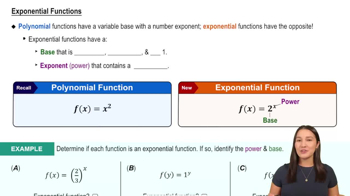
Exponential Functions
Exponential functions involve expressions where a constant base is raised to a variable exponent, such as e^(9x). Understanding their properties, like growth behavior and how to manipulate exponents, is essential for simplifying or evaluating these expressions.
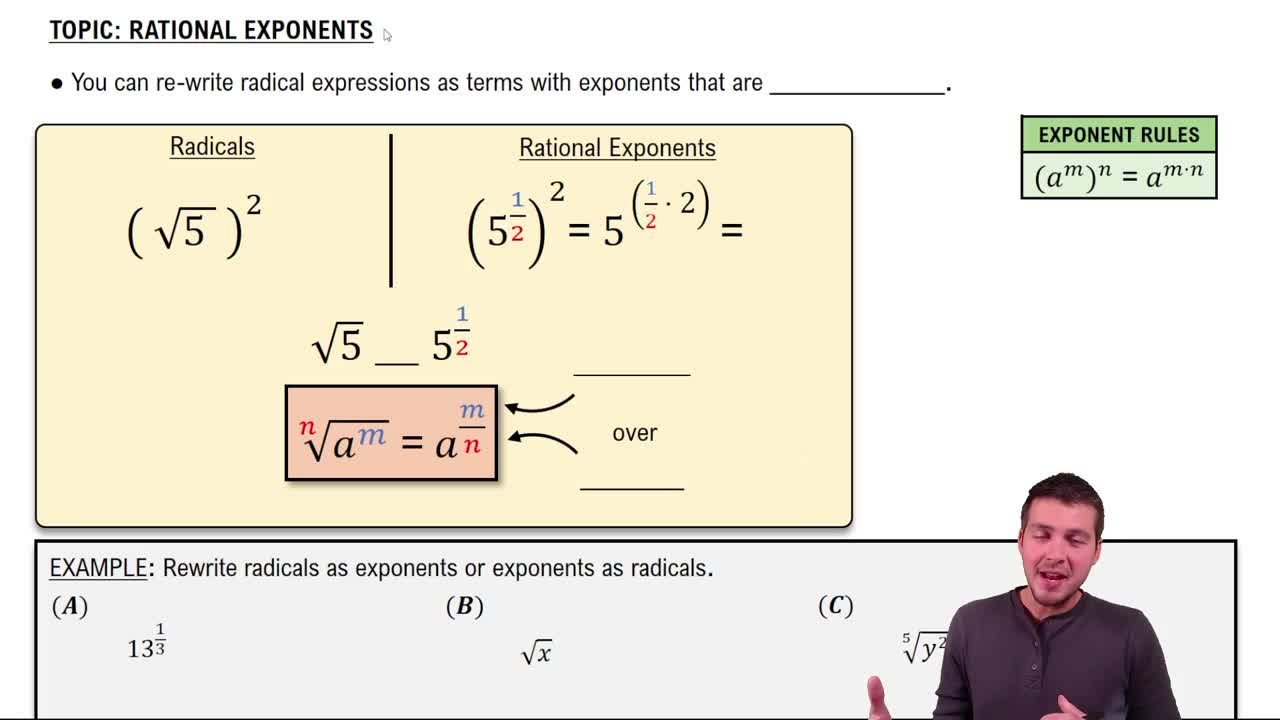
The properties of exponents include rules like a^(m+n) = a^m * a^n and (a^m)^n = a^(mn). These rules allow for the simplification and evaluation of exponential expressions without a calculator by combining or breaking down exponents.
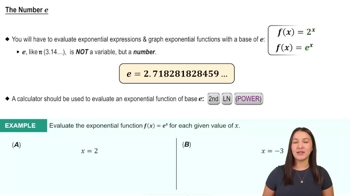
The number e (~2.718) is the base of natural logarithms and exponential functions. Recognizing e as a special constant helps in understanding continuous growth models and simplifies working with expressions like e^(9x) in algebra.