Ch. 4 - Exponential and Logarithmic Functions
Blitzer - College Algebra 8th Edition
Blitzer8th EditionCollege AlgebraISBN: 9780136970514Not the one you use?Change textbook
Chapter 5, Problem 92

Graph f(x) = 2x and its inverse function in the same rectangular coordinate system.

Verified step by step guidance
1
Identify the given function: \(f(x) = 2^x\). This is an exponential function where the base is 2.
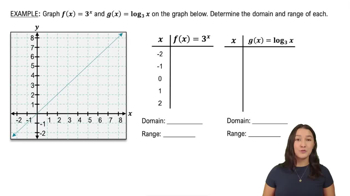
Recall that the inverse function of \(f(x) = 2^x\) is the logarithmic function with base 2, written as \(f^{-1}(x) = \log_2(x)\).
To graph \(f(x) = 2^x\), plot key points such as \((0, 1)\) because \$2^0 = 1\(, \)(1, 2)\( because \)2^1 = 2$, and \((-1, \frac{1}{2})\) because \(2^{-1} = \frac{1}{2}\). Connect these points with a smooth curve increasing from left to right.
To graph the inverse \(f^{-1}(x) = \log_2(x)\), plot points by swapping the coordinates of the points from \(f(x)\). For example, from \((0,1)\) on \(f(x)\), plot \((1,0)\) on \(f^{-1}(x)\); from \((1,2)\) on \(f(x)\), plot \((2,1)\) on \(f^{-1}(x)\); and from \((-1, \frac{1}{2})\) on \(f(x)\), plot \((\frac{1}{2}, -1)\) on \(f^{-1}(x)\). Connect these points with a smooth curve increasing from left to right.
Draw the line \(y = x\) as a reference line. The graphs of \(f(x)\) and \(f^{-1}(x)\) are symmetric with respect to this line, which helps verify the accuracy of your graphs.

Verified video answer for a similar problem:

This video solution was recommended by our tutors as helpful for the problem above.
Video duration:
6m
Was this helpful?

Key Concepts

Here are the essential concepts you must grasp in order to answer the question correctly.

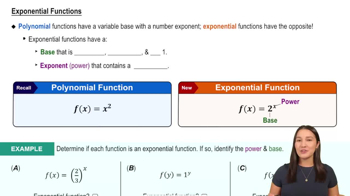
Exponential Functions

An exponential function has the form f(x) = a^x, where a is a positive constant not equal to 1. It models rapid growth or decay and has a domain of all real numbers and a range of positive real numbers. For f(x) = 2^x, the graph passes through (0,1) and increases exponentially as x increases.
Recommended video:
6:13
Exponential Functions

Inverse Functions

An inverse function reverses the effect of the original function, swapping inputs and outputs. For f(x) = 2^x, its inverse is the logarithmic function f⁻¹(x) = log₂(x). Graphically, the inverse reflects the original function across the line y = x, exchanging the roles of x and y.
Recommended video:
4:30
Graphing Logarithmic Functions

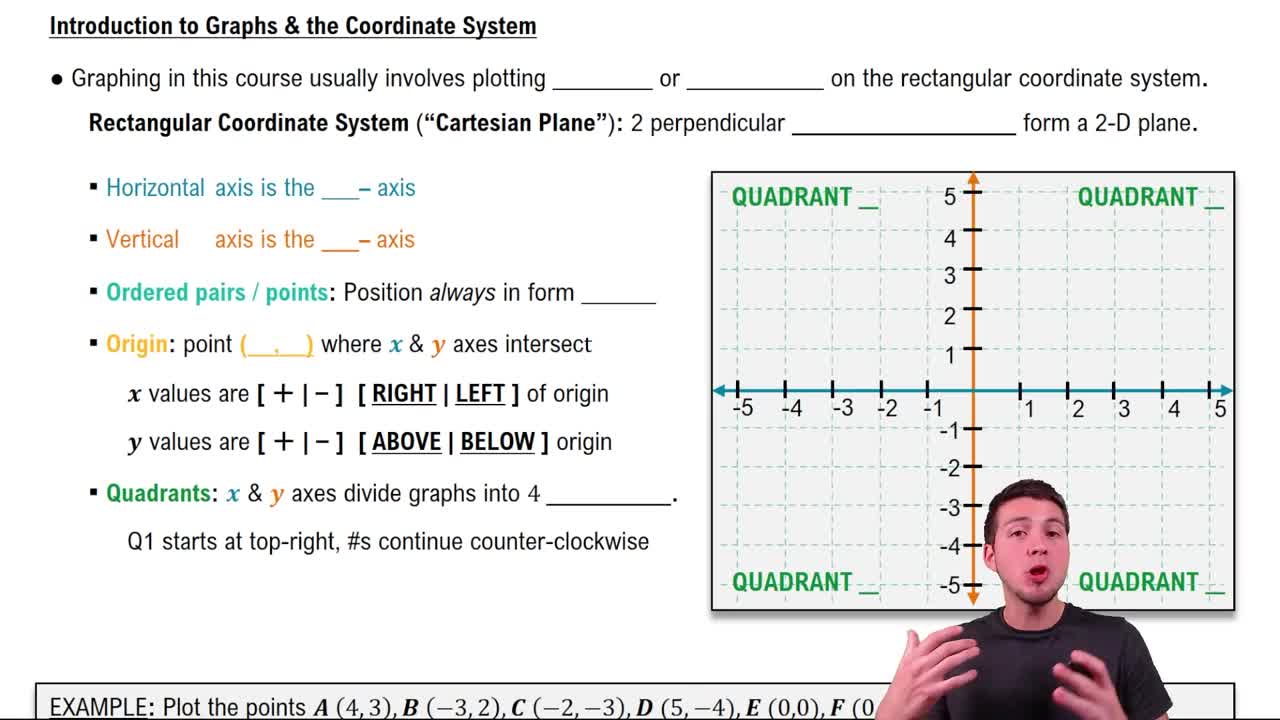
Graphing on Rectangular Coordinate System

Graphing functions on the rectangular coordinate system involves plotting points (x, y) to visualize their behavior. When graphing a function and its inverse together, the line y = x serves as a mirror, helping to verify the correctness of the inverse by symmetry. Understanding scale and intercepts aids in accurate plotting.
Recommended video:
Guided course
05:10
Graphs & the Rectangular Coordinate System