Ch. 4 - Exponential and Logarithmic Functions
Blitzer - College Algebra 8th Edition
Blitzer8th EditionCollege AlgebraISBN: 9780136970514Not the one you use?Change textbook
Chapter 5, Problem 128

In Exercises 125–128, determine whether each statement is true or false. If the statement is false, make the necessary change(s) to produce a true statement.
logb (xy)5 = (logb x + logb y)5

Verified step by step guidance
1
Recall the logarithm property for the logarithm of a product: logb(xy) = logbx + logby. This means the log of a product is the sum of the logs.
Apply the power rule of logarithms: logb(a)n = n logba. This means the exponent can be brought in front as a multiplier.
Rewrite the left side of the equation using these properties: logb(xy)5 = 5 logb(xy).
Next, use the product rule inside the logarithm: 5 logb(xy) = 5 ( logbx + logby ).
Compare this with the right side of the original statement: ( logbx + logby )^5. Notice that the original statement raises the sum to the fifth power, which is different from multiplying the sum by 5. Therefore, the original statement is false, and the correct statement is logb(xy)5 = 5 ( logbx + logby ).

Verified video answer for a similar problem:

This video solution was recommended by our tutors as helpful for the problem above.
Video duration:
3m
Was this helpful?

Key Concepts

Here are the essential concepts you must grasp in order to answer the question correctly.

Properties of Logarithms

Logarithms have specific properties that simplify expressions, such as the product rule: log_b(xy) = log_b(x) + log_b(y), and the power rule: log_b(x^n) = n * log_b(x). Understanding these rules is essential to manipulate and evaluate logarithmic expressions correctly.
Recommended video:
5:36
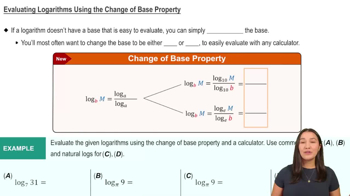
Change of Base Property

Exponentiation and Logarithms

When an exponent is applied to a product inside a logarithm, the power rule allows the exponent to be factored out: log_b((xy)^5) = 5 * log_b(xy). This differs from raising the sum of logarithms to a power, which is not equivalent, highlighting the importance of correctly applying exponent rules in logarithmic contexts.
Recommended video:
5:02
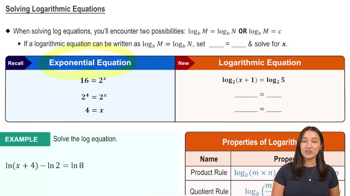
Solving Logarithmic Equations

Distinguishing Between Expressions and Their Equivalents

It is crucial to recognize that (log_b x + log_b y)^5 is not the same as 5 * (log_b x + log_b y). The former raises the entire sum to the fifth power, while the latter multiplies the sum by 5. This distinction helps avoid common mistakes when simplifying or verifying logarithmic statements.
Recommended video:
Guided course
05:09
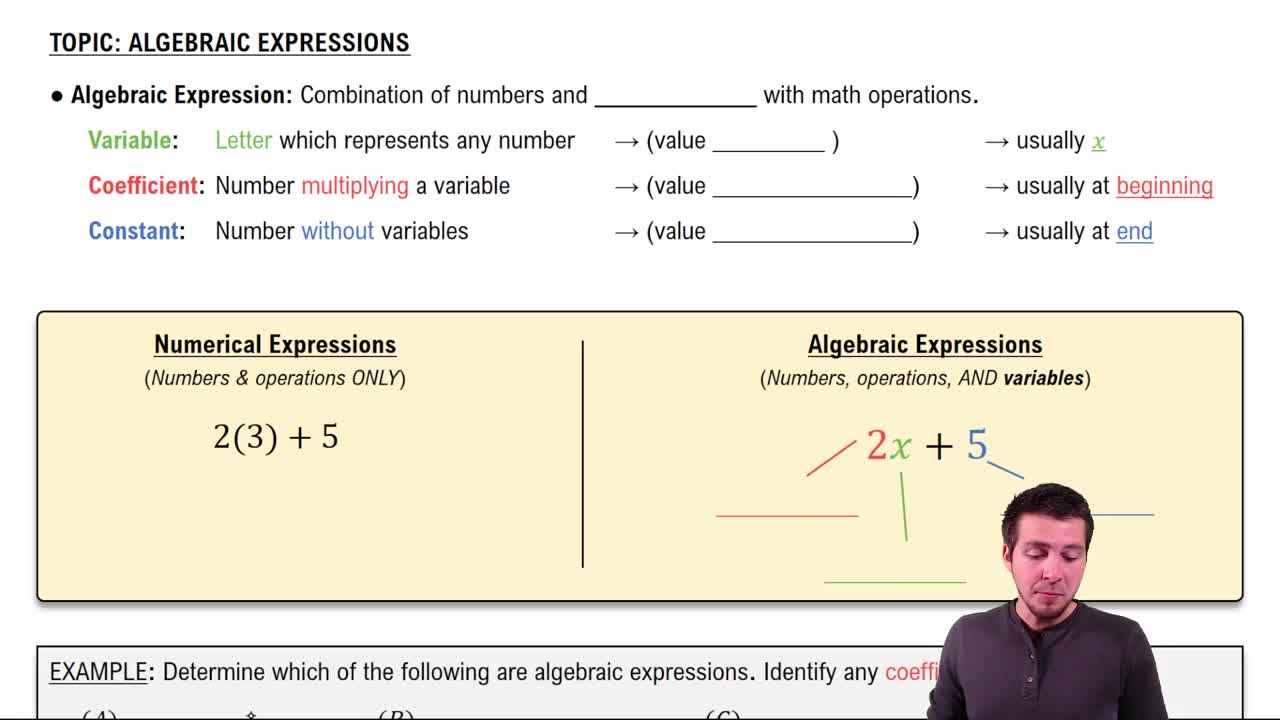
Introduction to Algebraic Expressions