Ch. 5 - Systems of Equations and Inequalities
Blitzer - College Algebra 8th Edition
Blitzer8th EditionCollege AlgebraISBN: 9780136970514Not the one you use?Change textbook
Chapter 6, Problem 5

Graph each inequality. y≤(1/3)x

Verified step by step guidance
1
Identify the inequality given: \(y \leq \frac{1}{3}x\). This means we are looking for all points \((x, y)\) where the \(y\)-value is less than or equal to one-third of the \(x\)-value.
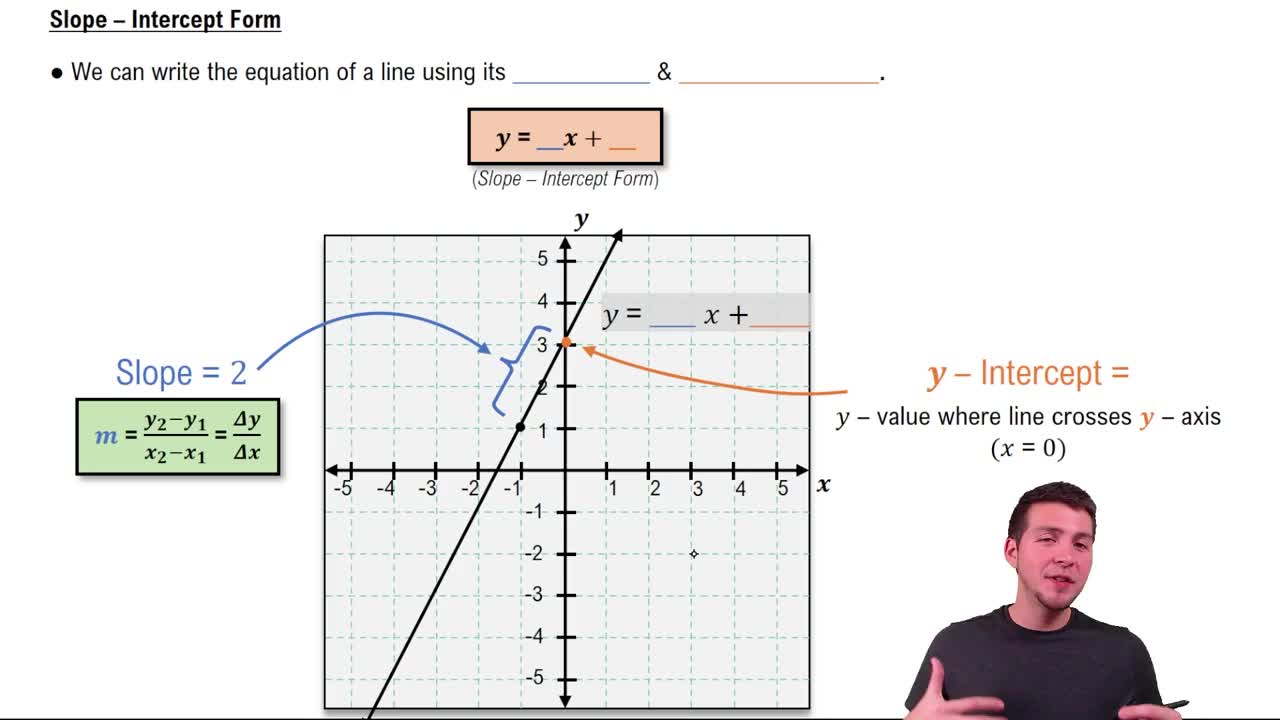
Start by graphing the boundary line \(y = \frac{1}{3}x\). This is a straight line with slope \(\frac{1}{3}\) passing through the origin \((0,0)\).
Since the inequality is \(\leq\) (less than or equal to), the boundary line should be drawn as a solid line to indicate that points on the line satisfy the inequality.
Next, choose a test point not on the line, commonly \((0,0)\) if it is not on the boundary line, to determine which side of the line to shade. Substitute the test point into the inequality to check if it satisfies \(y \leq \frac{1}{3}x\).
Shade the region of the coordinate plane where the inequality holds true based on the test point result. This shaded area represents all solutions to the inequality.

Verified video answer for a similar problem:

This video solution was recommended by our tutors as helpful for the problem above.
Video duration:
5m
Was this helpful?

Key Concepts

Here are the essential concepts you must grasp in order to answer the question correctly.

Graphing Linear Inequalities

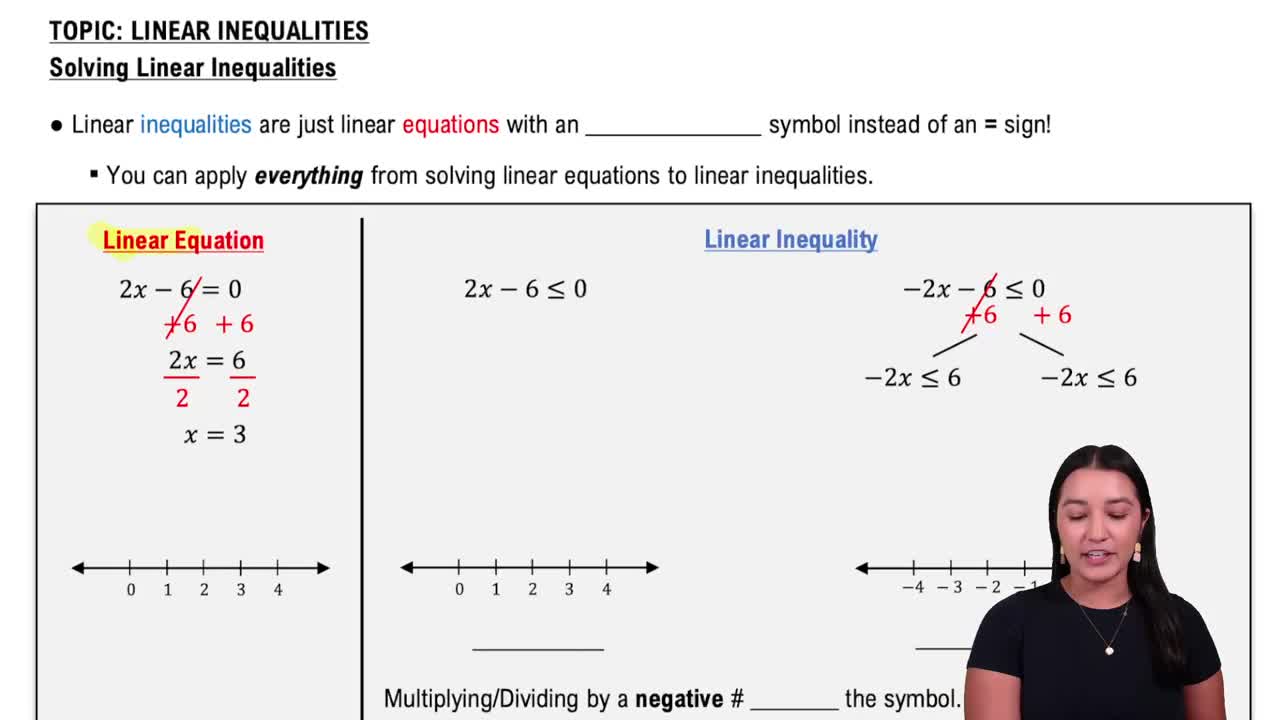
Graphing linear inequalities involves plotting the boundary line of the related equation and then shading the region that satisfies the inequality. For y ≤ (1/3)x, the boundary line is y = (1/3)x, and the area below or on this line is shaded to represent all solutions.
Recommended video:
06:07
Linear Inequalities

Slope-Intercept Form

The slope-intercept form of a line is y = mx + b, where m is the slope and b is the y-intercept. In y ≤ (1/3)x, the slope is 1/3 and the y-intercept is 0, which helps in accurately drawing the boundary line on the coordinate plane.
Recommended video:
Guided course
03:56
Slope-Intercept Form

Solid vs. Dashed Boundary Lines

When graphing inequalities, a solid line is used if the inequality includes equality (≤ or ≥), indicating points on the line satisfy the inequality. A dashed line is used for strict inequalities (< or >), meaning points on the line are not included.
Recommended video:
Guided course
07:52
Parallel & Perpendicular Lines
Related Practice
Textbook Question

In Exercises 5–18, solve each system by the substitution method. {x+3y=8y=2x9\(\begin{cases}\)x + 3y = 8 \(\y\) = 2x - 9\(\end{cases}\)

774
views
Textbook Question

An objective function and a system of linear inequalities representing constraints are given. a. Graph the system of inequalities representing the constraints. b. Find the value of the objective function at each corner of the graphed region. c. Use the values in part (b) to determine the maximum value of the objective function and the values of x and y for which the maximum occurs.

626
views
Textbook Question

Solve each system in Exercises 5–18.

{x+y+2z=11x+y+3z=14x+2yz=5\(\begin{cases}\)x + y + 2z = 11 \(\x\) + y + 3z = 14 \(\x\) + 2y - z = 5\(\end{cases}\)

629
views
Textbook Question

Write the form of the partial fraction decomposition of the rational expression. It is not necessary to solve for the constants. 5x26x+7(x1)(x2+1)\(\frac{5x^2 - 6x + 7}{(x - 1)(x^2 + 1)}\)

703
views
Textbook Question

An objective function and a system of linear inequalities representing constraints are given. a. Graph the system of inequalities representing the constraints. b. Find the value of the objective function at each corner of the graphed region. c. Use the values in part (b) to determine the maximum value of the objective function and the values of x and y for which the maximum occurs.

578
views
Textbook Question

In Exercises 1–18, solve each system by the substitution method. {y=x24x10y=x22x+14\(\begin{cases}\)y = x^2 - 4x - 10 \(\y\) = -x^2 - 2x + 14\(\end{cases}\)

546
views