Ch. 6 - Matrices and Determinants
Blitzer - College Algebra 8th Edition
Blitzer8th EditionCollege AlgebraISBN: 9780136970514Not the one you use?Change textbook
Chapter 7, Problem 5

Write the augmented matrix for each system of linear equations.
{5x2y3z=0x+y=52x3z=4\(\begin{cases}\)5x - 2y - 3z = 0 \(\x\) + y = 5 \\2x - 3z = 4\(\end{cases}\)

Verified step by step guidance
1
Identify the coefficients of each variable in each equation. For the first equation \$5x - 2y - 3z = 0\(, the coefficients are 5 for \)x\(, -2 for \)y\(, and -3 for \)z$.
For the second equation \(x + y = 5\), note that \(z\) is missing, so its coefficient is 0. The coefficients are 1 for \(x\), 1 for \(y\), and 0 for \(z\).
For the third equation \$2x - 3z = 4\(, note that \)y\( is missing, so its coefficient is 0. The coefficients are 2 for \)x\(, 0 for \)y\(, and -3 for \)z$.
Write the augmented matrix by placing the coefficients of \(x\), \(y\), and \(z\) in columns, and the constants on the right side as the augmented part. The matrix will have three rows corresponding to the three equations.
The augmented matrix will look like this: \[\left[\begin{array}{ccc|c} 5 & -2 & -3 & 0 \\ 1 & 1 & 0 & 5 \\ 2 & 0 & -3 & 4 \end{array}\right]\]

Verified video answer for a similar problem:

This video solution was recommended by our tutors as helpful for the problem above.
Video duration:
3m
Was this helpful?

Key Concepts

Here are the essential concepts you must grasp in order to answer the question correctly.

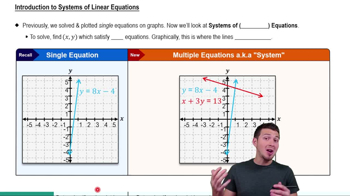
System of Linear Equations

A system of linear equations consists of two or more linear equations involving the same set of variables. The goal is to find values for the variables that satisfy all equations simultaneously. Understanding how to interpret and manipulate these equations is fundamental for solving or representing them in matrix form.
Recommended video:
Guided course
4:27
Introduction to Systems of Linear Equations

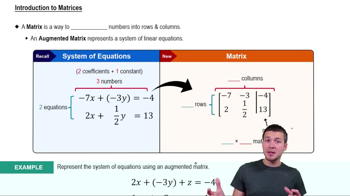
Augmented Matrix

An augmented matrix represents a system of linear equations by combining the coefficient matrix and the constants into one matrix. Each row corresponds to an equation, with the last column containing the constants from the right side of the equations. This format simplifies solving systems using matrix operations.
Recommended video:
Guided course
4:35
Introduction to Matrices

Matrix Representation of Equations

Matrix representation involves organizing the coefficients of variables and constants from a system of equations into a rectangular array. This structured form allows the use of matrix methods such as row operations and Gaussian elimination to solve the system efficiently.
Recommended video:
06:00
Categorizing Linear Equations
Related Practice
Textbook Question

In Exercises 5 - 8, find values for the variables so that the matrices in each exercise are equal. [x4]=[6y]\(\begin{bmatrix}\)x \\4\(\end{bmatrix}\)=\(\begin{bmatrix}\)6 \(\y\]\end{bmatrix}\)

204
views
Textbook Question

Solve each system of equations using matrices. Use Gaussian elimination with back-substitution or Gauss-Jordan elimination.

{3x1+5x28x3+5x4=8x1+2x23x3+x4=72x1+3x27x3+3x4=114x1+8x210x3+7x4=10\(\begin{cases}\) 3x_1 + 5x_2 - 8x_3 + 5x_4 = -8 \\ x_1 + 2x_2 - 3x_3 + x_4 = -7 \\ 2x_1 + 3x_2 - 7x_3 + 3x_4 = -11 \\ 4x_1 + 8x_2 - 10x_3 + 7x_4 = -10 \(\end{cases}\)

956
views
Textbook Question

In Exercises 5 - 8, find values for the variables so that the matrices in each exercise are equal. [x2yz9]=[41239]\(\begin{bmatrix}\)x & 2y \(\z\) & 9\(\end{bmatrix}\)=\(\begin{bmatrix}\)4 & 12 \\3 & 9\(\end{bmatrix}\)

192
views
Textbook Question

Find the products AB and BA to determine whether B is the multiplicative inverse of A.

A=[213212],B=[1234]A = \(\begin{bmatrix}\) -2 & 1 \\ \(\frac{3}{2}\) & -\(\frac{1}{2}\) \(\end{bmatrix}\), \(\quad\) B = \(\begin{bmatrix}\) 1 & 2 \\ 3 & 4 \(\end{bmatrix}\)

600
views
Textbook Question

Find the products AB and BA to determine whether B is the multiplicative inverse of A.

A=[010001100],B=[001100010]A = \(\begin{bmatrix}\) 0 & 1 & 0 \\ 0 & 0 & 1 \\ 1 & 0 & 0 \(\end{bmatrix}\), \(\quad\) B = \(\begin{bmatrix}\) 0 & 0 & 1 \\ 1 & 0 & 0 \\ 0 & 1 & 0 \(\end{bmatrix}\)

702
views
Textbook Question

Evaluate each determinant in Exercises 1–10.

5127\(\begin{vmatrix}\)-5 & -1 \\-2 & -7\(\end{vmatrix}\)

757
views