Begin by graphing the square root function, f(x) = √x. Then use transformations of this graph to graph the given function. h(x) = √(x+1)-1
Ch. 2 - Functions and Graphs

Chapter 3, Problem 77a
Express the given function h as a composition of two functions ƒ and g so that h(x) = (fog) (x). h(x) = ∛(x² – 9)
Verified step by step guidance1
Step 1: Understand the problem. The goal is to express the given function h(x) = ∛(x² – 9) as a composition of two functions ƒ(x) and g(x) such that h(x) = (ƒ ∘ g)(x), which means h(x) = ƒ(g(x)).
Step 2: Identify the inner function g(x). Look at the expression inside the cube root, x² – 9. This suggests that g(x) = x² – 9.
Step 3: Identify the outer function ƒ(x). The outer function operates on the result of g(x). Since h(x) = ∛(x² – 9), the cube root operation applies to g(x). Therefore, ƒ(x) = ∛x or equivalently ƒ(x) = x^(1/3).
Step 4: Verify the composition. Substitute g(x) into ƒ(g(x)) to ensure it matches h(x). ƒ(g(x)) = ƒ(x² – 9) = ∛(x² – 9), which is the original h(x).
Step 5: Conclude that the functions are ƒ(x) = x^(1/3) and g(x) = x² – 9, and their composition satisfies h(x) = (ƒ ∘ g)(x).

Verified video answer for a similar problem:
This video solution was recommended by our tutors as helpful for the problem above.
Video duration:
2mWas this helpful?
Key Concepts
Here are the essential concepts you must grasp in order to answer the question correctly.
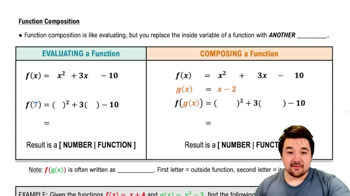
Function Composition
Function composition involves combining two functions, where the output of one function becomes the input of another. In this context, if h(x) = (f o g)(x), it means h(x) can be expressed as f(g(x)). Understanding how to break down a function into simpler components is essential for solving the problem.
Recommended video:
Function Composition
Cube Root Function
The cube root function, denoted as ∛x, is the inverse of the cubic function x³. It is important to recognize how this function behaves, particularly its domain and range, as well as how it can be manipulated algebraically. In the given function h(x) = ∛(x² - 9), understanding the cube root will help in identifying suitable functions f and g.
Recommended video:
Imaginary Roots with the Square Root Property
Quadratic Functions
Quadratic functions are polynomial functions of the form ax² + bx + c, where a, b, and c are constants. In the expression x² - 9, we see a difference of squares, which can be factored. Recognizing the structure of quadratic expressions is crucial for determining how to express h(x) as a composition of two simpler functions.
Recommended video:
Solving Quadratic Equations Using The Quadratic Formula
Related Practice
Textbook Question
780
views
Textbook Question
Give the slope and y-intercept of each line whose equation is given. Assume that B ≠ 0. Ax = By - C
124
views
Textbook Question
Use the graph to determine a.the x-intercepts, if any; b. the y-intercept, if any; and e. the missing function values, indicated by question marks, below each graph.
962
views
Textbook Question
Use the graph to determine a.the x-intercepts, if any; b. the y-intercept, if any; and e. the missing function values, indicated by question marks, below each graph.
96
views
Textbook Question
Find the domain of each function. g(x) = 4/(x - 7)
1155
views
Textbook Question
In Exercises 77–92, use the graph to determine a.the x-intercepts, if any; b. the y-intercept, if any; and e. the missing function values, indicated by question marks, below each graph.
826
views