In Exercises 35–46, determine the constant that should be added to the binomial so that it becomes a perfect square trinomial. Then write and factor the trinomial.
Ch. 1 - Equations and Inequalities

Chapter 2, Problem 43
In all exercises, other than exercises with no solution, use interval notation to express solution sets and graph each solution set on a number line. In Exercises 27–50, solve each linear inequality. 1 - x/2 > 4
Verified step by step guidance1
Start with the given inequality: \(1 - \frac{x}{2} > 4\).
Isolate the term containing \(x\) by subtracting 1 from both sides: \(1 - \frac{x}{2} - 1 > 4 - 1\), which simplifies to \(- \frac{x}{2} > 3\).
To solve for \(x\), multiply both sides of the inequality by \(-2\) to eliminate the fraction. Remember, when multiplying or dividing an inequality by a negative number, you must reverse the inequality sign: \(x < -6\).
Express the solution in interval notation. Since \(x\) is less than \(-6\), the solution set is \((-\infty, -6)\).
To graph the solution on a number line, draw a number line, mark the point \(-6\) with an open circle (because \(x\) is strictly less than \(-6\), not equal), and shade all values to the left of \(-6\).

Verified video answer for a similar problem:
This video solution was recommended by our tutors as helpful for the problem above.
Video duration:
3mWas this helpful?
Key Concepts
Here are the essential concepts you must grasp in order to answer the question correctly.
Solving Linear Inequalities
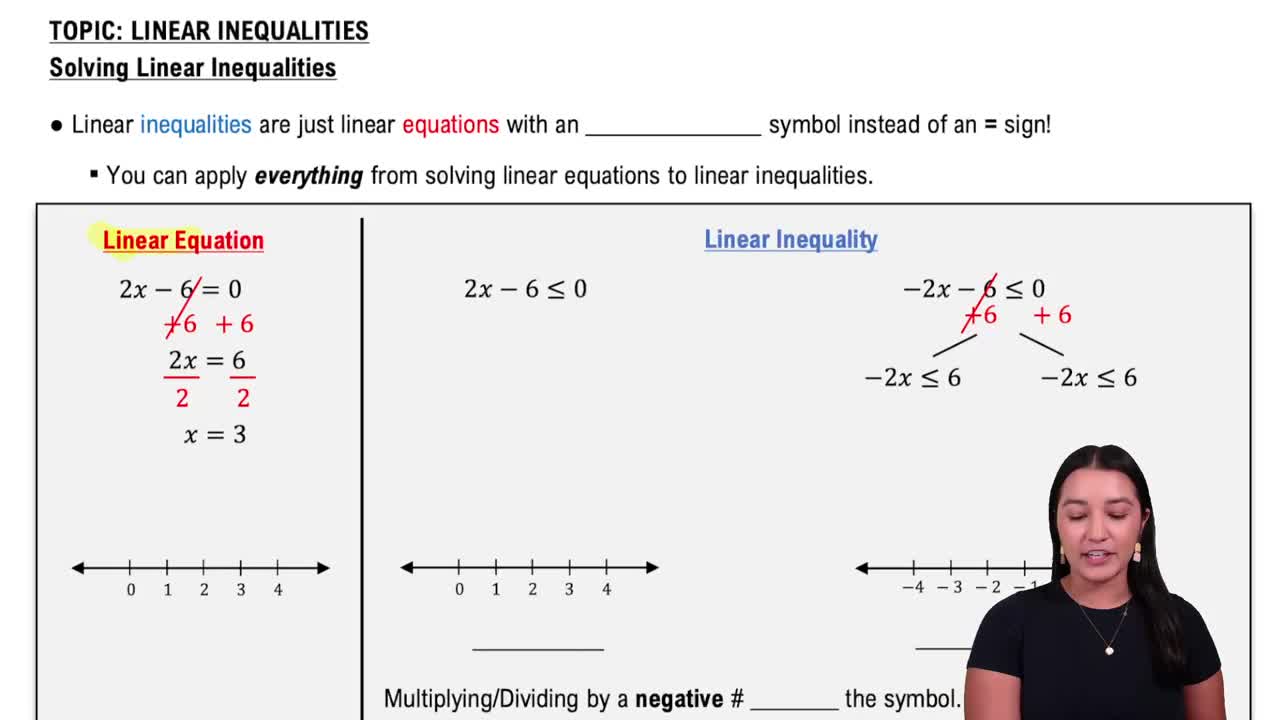
Linear inequalities involve expressions with variables raised to the first power and inequality signs (>, <, ≥, ≤). To solve them, isolate the variable on one side by performing inverse operations, similar to solving linear equations, but pay attention to inequality rules.
Recommended video:
Linear Inequalities
Effect of Multiplying or Dividing by Negative Numbers
When solving inequalities, multiplying or dividing both sides by a negative number reverses the inequality sign. This rule is crucial to maintain the inequality's truth and must be applied carefully during the solution process.
Recommended video:
Dividing Complex Numbers
Interval Notation and Number Line Graphing
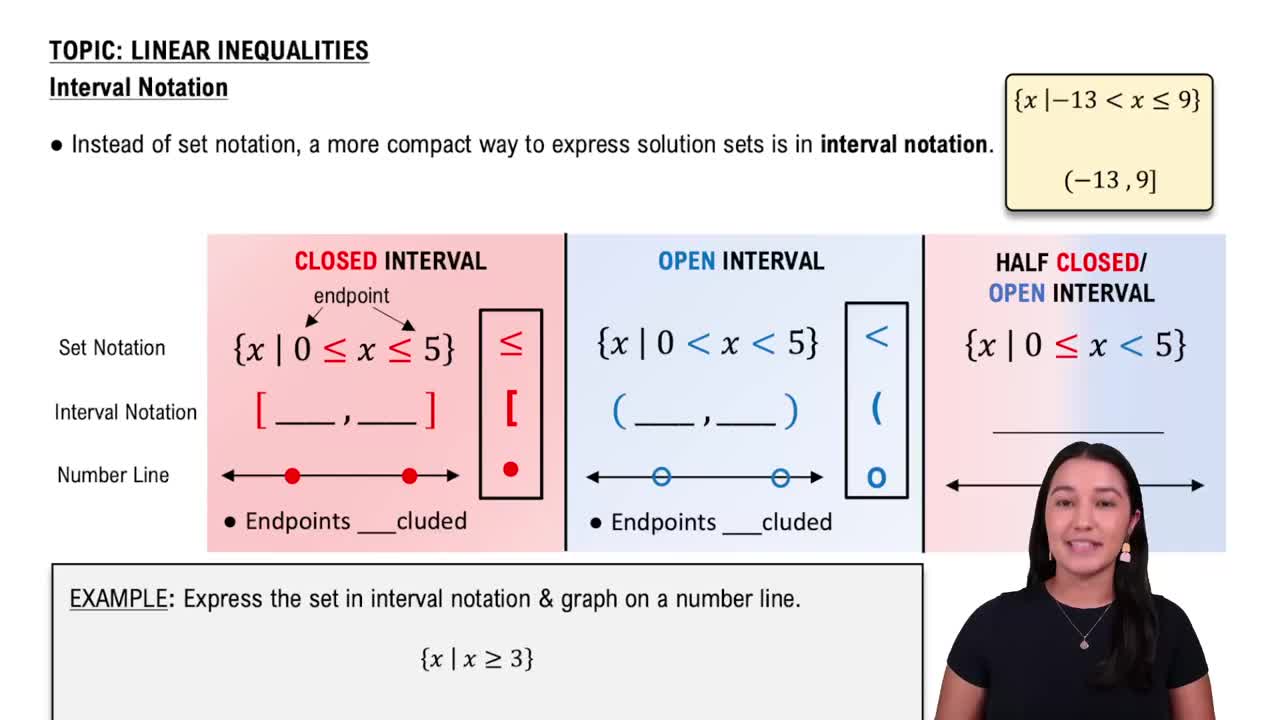
Interval notation expresses solution sets using parentheses and brackets to indicate open or closed intervals. Graphing on a number line visually represents these solutions, showing which values satisfy the inequality and whether endpoints are included.
Recommended video:
Interval Notation
Related Practice
Textbook Question
956
views
Textbook Question
In Exercises 37–52, perform the indicated operations and write the result in standard form. (- 3 - √-7)2
830
views
Textbook Question
Use the graph to a. determine the x-intercepts, if any; b. determine the y-intercepts, if any. For each graph, tick marks along the axes represent one unit each.
1173
views
Textbook Question
Solve each equation in Exercises 41–60 by making an appropriate substitution.
720
views
Textbook Question
In all exercises, other than exercises with no solution, use interval notation to express solution sets and graph each solution set on a number line. In Exercises 27–50, solve each linear inequality. x/4 - 3/2 ≤ x/2 + 1
822
views
Textbook Question
Use the graph to a. determine the x-intercepts, if any; b. determine the y-intercepts, if any. For each graph, tick marks along the axes represent one unit each.
130
views