Ch. 1 - Equations and Inequalities
Blitzer - College Algebra 8th Edition
Blitzer8th EditionCollege AlgebraISBN: 9780136970514Not the one you use?Change textbook
Chapter 2, Problem 122a

What is an identity equation? Give an example.

Verified step by step guidance
1
An identity equation is an equation that is true for all values of the variable(s) involved. In other words, no matter what value you substitute for the variable, the equation will always hold true.
For example, consider the equation: x+2=x+2. This equation is true for any value of x because both sides are identical.
To verify that an equation is an identity, simplify both sides of the equation as much as possible. If the simplified forms of both sides are identical, the equation is an identity.
For instance, if we simplify 2(x+1)=2x+2, we distribute the 2 on the left-hand side to get 2x+2, which matches the right-hand side. Thus, this is an identity equation.
In summary, identity equations are always true regardless of the variable's value, and they often simplify to the same expression on both sides of the equation.

Verified video answer for a similar problem:

This video solution was recommended by our tutors as helpful for the problem above.
Video duration:
1m
Was this helpful?

Key Concepts

Here are the essential concepts you must grasp in order to answer the question correctly.

Identity Equation

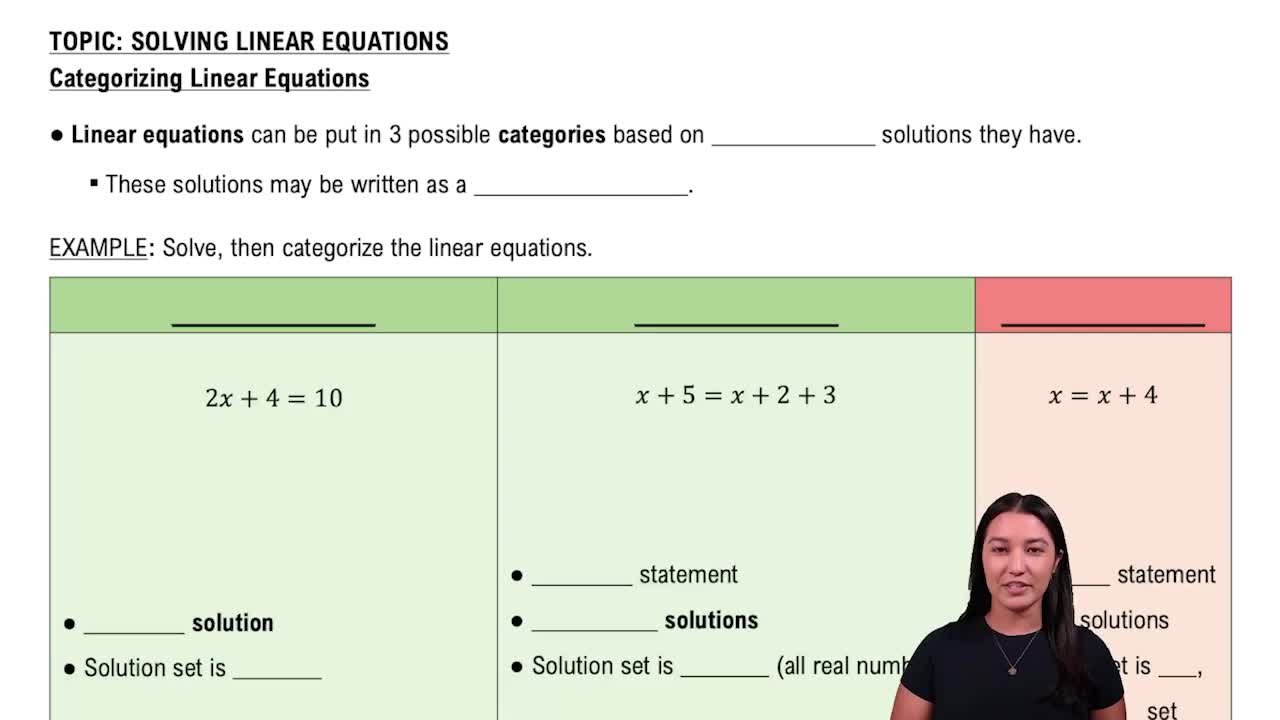
An identity equation is an equation that holds true for all values of the variable involved. This means that no matter what value you substitute for the variable, the equation will always be satisfied. For example, the equation 2(x + 3) = 2x + 6 is an identity because it simplifies to the same expression on both sides for any value of x.
Recommended video:
06:00
Categorizing Linear Equations

Algebraic Manipulation

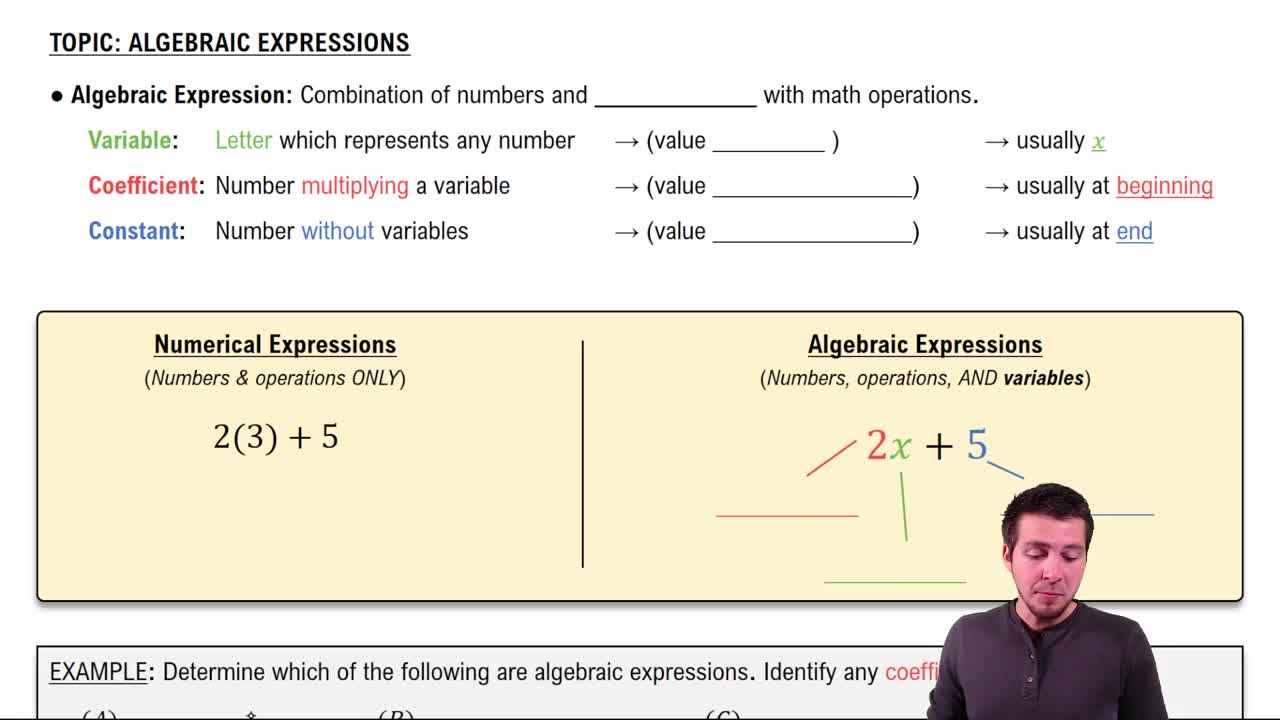
Algebraic manipulation refers to the process of rearranging and simplifying expressions and equations using algebraic rules. This includes operations such as adding, subtracting, multiplying, and dividing both sides of an equation, as well as applying the distributive property. Mastery of these techniques is essential for identifying and proving identity equations.
Recommended video:
Guided course
05:09
Introduction to Algebraic Expressions

Examples of Identity Equations

Examples of identity equations help illustrate the concept clearly. Common examples include equations like sin²(x) + cos²(x) = 1 or (x - 1)(x + 1) = x² - 1. These equations are true for all values of x, demonstrating the nature of identity equations and their importance in algebra and trigonometry.
Recommended video:
06:00
Categorizing Linear Equations