
The National Weather Service releases approximately radiosondes every year to collect data from the atmosphere. Attached to a balloon, a radiosonde rises at about ft/min until the balloon bursts in the upper atmosphere. Suppose a radiosonde is released from a point ft above the ground and that seconds later, it is ft above the ground. Let represent the height (in feet) that the radiosonde is above the ground seconds after it is released. Evaluate and interpret the meaning of this quotient.
Ch. 1 - Functions
Briggs3rd EditionCalculus: Early TranscendentalsISBN: 9780136847243Not the one you use?Change textbook
Chapter 1, Problem 1.59
Finding inverses Find the inverse function.
ƒ(x) = 3x² + 1, for x ≤ 0
Verified step by step guidance1
Step 1: Understand the function and its domain. The function given is \( f(x) = 3x^2 + 1 \) with the domain \( x \leq 0 \). This means we are only considering the left half of the parabola.
Step 2: Replace \( f(x) \) with \( y \) to make it easier to work with: \( y = 3x^2 + 1 \).
Step 3: Solve for \( x \) in terms of \( y \). Start by isolating the \( x^2 \) term: \( y - 1 = 3x^2 \).
Step 4: Divide both sides by 3 to further isolate \( x^2 \): \( \frac{y - 1}{3} = x^2 \).
Step 5: Since \( x \leq 0 \), take the negative square root to solve for \( x \): \( x = -\sqrt{\frac{y - 1}{3}} \). This expression represents the inverse function, \( f^{-1}(y) \).

Verified video answer for a similar problem:
This video solution was recommended by our tutors as helpful for the problem above.
Video duration:
3mWas this helpful?
Key Concepts
Here are the essential concepts you must grasp in order to answer the question correctly.
Inverse Functions
An inverse function essentially reverses the effect of the original function. If a function f takes an input x and produces an output y, the inverse function f⁻¹ takes y back to x. For a function to have an inverse, it must be one-to-one, meaning each output is produced by exactly one input.
Recommended video:
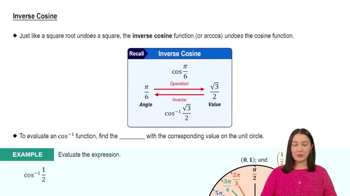
Inverse Cosine
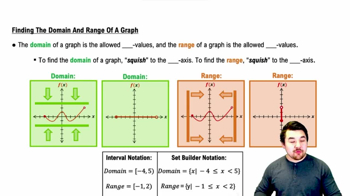
Domain and Range
The domain of a function is the set of all possible input values (x-values), while the range is the set of all possible output values (y-values). When finding an inverse function, it is crucial to consider the domain of the original function, as it affects the range of the inverse function. In this case, the restriction x ≤ 0 is important for determining the inverse.
Recommended video:
Finding the Domain and Range of a Graph
Solving for x
To find the inverse of a function, one typically starts by replacing f(x) with y, then solving for x in terms of y. This often involves algebraic manipulation, such as isolating x on one side of the equation. Once x is expressed in terms of y, the inverse function can be written as f⁻¹(y) = x, and then it can be rewritten in terms of x.
Recommended video:
Solving Logarithmic Equations
Related Practice
Textbook Question
514
views
Textbook Question
Solve each equation.
312
views
Textbook Question
Solving equations Solve the following equations.
7ˣ = 21
340
views
Textbook Question
Symmetry Determine whether the graphs of the following equations and functions are symmetric about the x-axis, the y-axis, or the origin. Check your work by graphing.
451
views
Textbook Question
Solving equations Solve the following equations.
log₈ x = 1/3
286
views
Textbook Question
Inverse sines and cosines Evaluate or simplify the following expressions without using a calculator.
cos (cos⁻¹ ( -1 ))
335
views
