51–56. Second derivatives Find d²y/dx². 2x²+y² = 4
Verified step by step guidance
1
First, identify the given equation: \(2x^2 + y^2 = 4\). This is an implicit function of \(x\) and \(y\).
Differentiate both sides of the equation with respect to \(x\) to find the first derivative \(\frac{dy}{dx}\). Use implicit differentiation: \(\frac{d}{dx}(2x^2) + \frac{d}{dx}(y^2) = \frac{d}{dx}(4)\).
Calculate the derivatives: \(\frac{d}{dx}(2x^2) = 4x\) and \(\frac{d}{dx}(y^2) = 2y \frac{dy}{dx}\). The right side derivative is zero since \(4\) is a constant.
Set up the equation from the derivatives: \(4x + 2y \frac{dy}{dx} = 0\). Solve for \(\frac{dy}{dx}\) to find the first derivative.
Differentiate \(\frac{dy}{dx}\) again with respect to \(x\) to find \(\frac{d^2y}{dx^2}\). Use the quotient rule or implicit differentiation as needed, and substitute \(\frac{dy}{dx}\) from the previous step into this new derivative.
Verified video answer for a similar problem:
This video solution was recommended by our tutors as helpful for the problem above
Video duration:
9m
Play a video:
0 Comments
Key Concepts
Here are the essential concepts you must grasp in order to answer the question correctly.
Implicit Differentiation
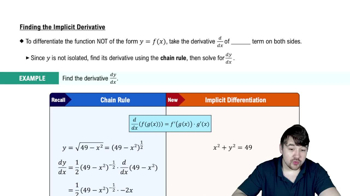
Implicit differentiation is a technique used to differentiate equations where the dependent and independent variables are not explicitly separated. In this case, the equation 2x² + y² = 4 involves both x and y, making it necessary to differentiate both sides with respect to x while treating y as a function of x. This allows us to find the first derivative dy/dx before proceeding to the second derivative.
The first derivative, denoted as dy/dx, represents the rate of change of the dependent variable y with respect to the independent variable x. It provides information about the slope of the tangent line to the curve defined by the equation at any given point. To find the second derivative, we first need to compute the first derivative using implicit differentiation.
The second derivative, denoted as d²y/dx², measures the rate of change of the first derivative. It provides insights into the curvature of the function, indicating whether the function is concave up or concave down at a given point. To find d²y/dx², we differentiate the first derivative again, applying implicit differentiation as necessary to account for the relationship between x and y.