Step 1: Identify the form of the limit. As x approaches e^2, substitute x = e^2 into the expression ln^2(x) - 5ln(x) + 6 to check if it results in an indeterminate form like 0/0.
Step 2: Substitute x = e^2 into the expression. Calculate ln(e^2) which simplifies to 2, and substitute this into the expression to see if it results in an indeterminate form.
Step 3: If the expression results in an indeterminate form, consider using algebraic manipulation or L'Hôpital's Rule. Simplify the expression if possible to resolve the indeterminate form.
Step 4: If using L'Hôpital's Rule, differentiate the numerator and the denominator separately with respect to x, and then take the limit again as x approaches e^2.
Step 5: Evaluate the limit after simplification or applying L'Hôpital's Rule to find the final value.
Verified video answer for a similar problem:
This video solution was recommended by our tutors as helpful for the problem above
Video duration:
2m
Play a video:
0 Comments
Key Concepts
Here are the essential concepts you must grasp in order to answer the question correctly.
Limits
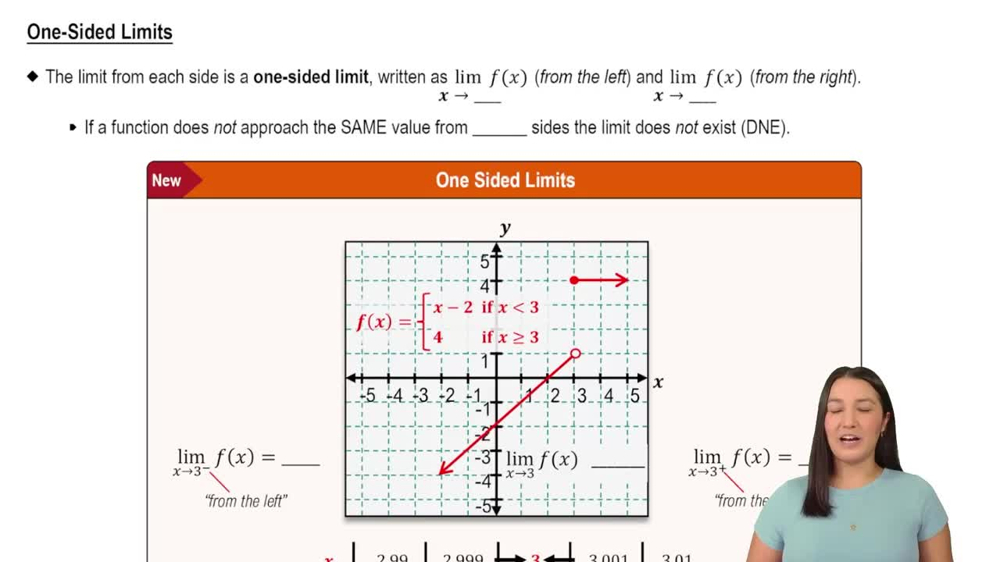
In calculus, a limit is a fundamental concept that describes the behavior of a function as its input approaches a certain value. It helps in understanding the function's behavior near points of interest, including points of discontinuity or infinity. Evaluating limits often involves techniques such as substitution, factoring, or applying L'Hôpital's rule when dealing with indeterminate forms.
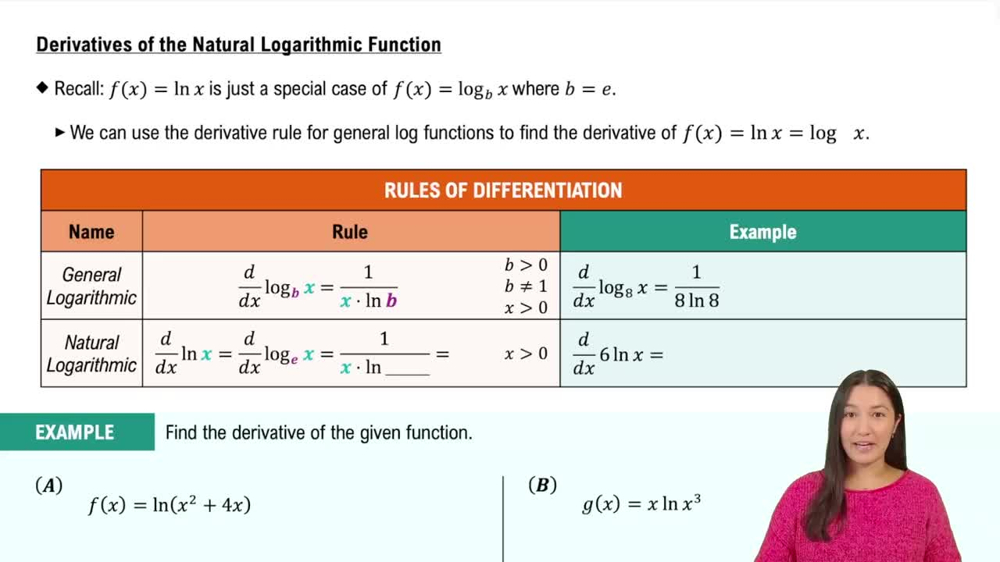
The natural logarithm, denoted as ln(x), is the logarithm to the base e, where e is approximately 2.71828. It is a key function in calculus, particularly in problems involving growth and decay, as well as in integration and differentiation. Understanding properties of logarithms, such as ln(ab) = ln(a) + ln(b) and ln(a^b) = b*ln(a), is essential for manipulating expressions involving logarithms.
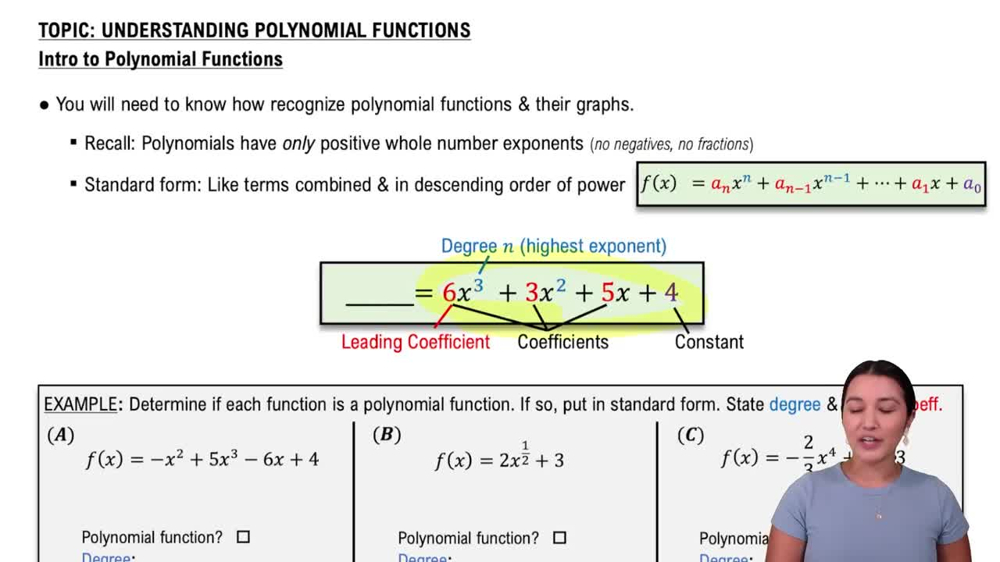
Polynomial functions are expressions that involve variables raised to whole number powers, combined using addition, subtraction, and multiplication. In the context of limits, polynomial functions can often be simplified or factored to evaluate limits more easily. Recognizing the structure of polynomial expressions is crucial for applying limit laws and determining the behavior of functions as they approach specific values.

 2:35 minutes
 Verified step by step guidance
 05:50
05:50