Ch. 4 - Applications of the Derivative
Briggs - Calculus: Early Transcendentals 3rd Edition
Briggs3rd EditionCalculus: Early TranscendentalsISBN: 9780136847243Not the one you use?Change textbook
Chapter 4, Problem 29

Graphing functions Use the guidelines of this section to make a complete graph of f.
f(x) = 3x/(x² - 1)

Verified step by step guidance
1
Identify the domain of the function f(x) = \( \frac{3x}{x^2 - 1} \). The denominator x² - 1 cannot be zero, so solve x² - 1 = 0 to find the values of x that are not in the domain.
Determine the vertical asymptotes by setting the denominator equal to zero and solving for x. This will give you the x-values where the function is undefined.
Find the horizontal asymptote by analyzing the behavior of f(x) as x approaches infinity or negative infinity. Since the degree of the numerator is less than the degree of the denominator, the horizontal asymptote is y = 0.
Calculate the first derivative f'(x) to find the critical points and determine intervals of increase and decrease. Use the quotient rule: \( f'(x) = \frac{(x^2 - 1)(3) - (3x)(2x)}{(x^2 - 1)^2} \). Simplify and solve f'(x) = 0 to find critical points.
Calculate the second derivative f''(x) to determine concavity and points of inflection. Use the quotient rule again on f'(x) and solve f''(x) = 0 to find potential inflection points. Analyze the sign of f''(x) to determine concavity intervals.

Verified video answer for a similar problem:

This video solution was recommended by our tutors as helpful for the problem above.
Video duration:
15m
Was this helpful?

Key Concepts

Here are the essential concepts you must grasp in order to answer the question correctly.

Function Behavior

Understanding the behavior of the function involves analyzing its domain, range, and asymptotic behavior. For the function f(x) = 3x/(x² - 1), we need to identify where the function is defined and where it may have vertical asymptotes, which occur where the denominator equals zero.
Recommended video:
5:46
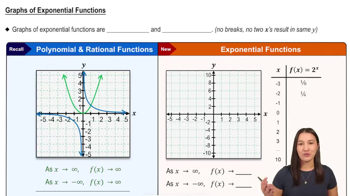
Graphs of Exponential Functions

Finding Asymptotes

Asymptotes are lines that the graph approaches but never touches. For rational functions like f(x) = 3x/(x² - 1), vertical asymptotes can be found by setting the denominator to zero, while horizontal asymptotes can be determined by analyzing the degrees of the numerator and denominator as x approaches infinity.
Recommended video:
05:21
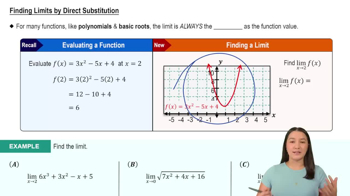
Finding Limits by Direct Substitution

Critical Points and Intervals

Critical points are where the derivative of the function is zero or undefined, indicating potential local maxima, minima, or points of inflection. Analyzing these points, along with the intervals of increase and decrease, helps in sketching the overall shape of the graph and understanding its key features.
Recommended video:
04:50
Critical Points