Ch. 3 - Derivatives
Briggs - Calculus: Early Transcendentals 3rd Edition
Briggs3rd EditionCalculus: Early TranscendentalsISBN: 9780136847243Not the one you use?Change textbook
Chapter 3, Problem 3.15

If f(t)=t¹⁰, find f′(t), f′′(t), and f′′′(t).

Verified step by step guidance
1
Step 1: To find the first derivative, f'(t), apply the power rule of differentiation. The power rule states that if f(t) = t^n, then f'(t) = n * t^(n-1). For f(t) = t^10, n = 10.
Step 2: Calculate f'(t) using the power rule: f'(t) = 10 * t^(10-1) = 10 * t^9.
Step 3: To find the second derivative, f''(t), differentiate f'(t) = 10 * t^9 again using the power rule. Here, n = 9.
Step 4: Calculate f''(t) using the power rule: f''(t) = 9 * 10 * t^(9-1) = 90 * t^8.
Step 5: To find the third derivative, f'''(t), differentiate f''(t) = 90 * t^8 once more using the power rule. Here, n = 8.

Verified video answer for a similar problem:

This video solution was recommended by our tutors as helpful for the problem above.
Video duration:
3m
Was this helpful?

Key Concepts

Here are the essential concepts you must grasp in order to answer the question correctly.

Differentiation

Differentiation is the process of finding the derivative of a function, which represents the rate of change of the function with respect to its variable. In this case, we will apply the power rule, which states that the derivative of t^n is n*t^(n-1), to find the first, second, and third derivatives of the function f(t) = t¹⁰.
Recommended video:
05:53
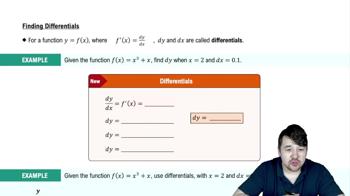
Finding Differentials

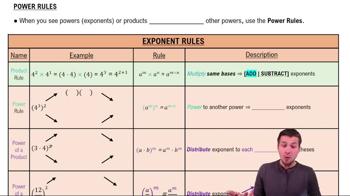
Power Rule

The power rule is a fundamental rule in calculus used to differentiate functions of the form f(t) = t^n, where n is a real number. According to this rule, the derivative f'(t) is calculated as n*t^(n-1). This rule simplifies the differentiation process, making it easier to compute higher-order derivatives.
Recommended video:

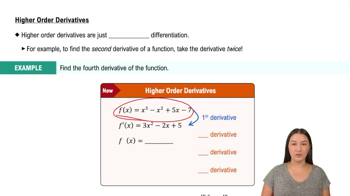
Higher-Order Derivatives

Higher-order derivatives refer to the derivatives of a function taken multiple times. The first derivative f'(t) gives the rate of change, the second derivative f''(t) provides information about the curvature or concavity of the function, and the third derivative f'''(t) can indicate the rate of change of the curvature. Understanding these derivatives is essential for analyzing the behavior of functions.
Recommended video:
02:42
Higher Order Derivatives