Ch. 3 - Derivatives
Briggs - Calculus: Early Transcendentals 3rd Edition
Briggs3rd EditionCalculus: Early TranscendentalsISBN: 9780136847243Not the one you use?Change textbook
Chapter 3, Problem 3.R.58

Evaluate and simplify y'.
sin x cos(y−1) = 1/2

Verified step by step guidance
1
First, identify the given equation: \( y' \cdot \sin(x) \cdot \cos(y - 1) = \frac{1}{2} \). Here, \( y' \) represents the derivative of \( y \) with respect to \( x \).
To isolate \( y' \), divide both sides of the equation by \( \sin(x) \cdot \cos(y - 1) \). This gives: \( y' = \frac{1}{2} \div (\sin(x) \cdot \cos(y - 1)) \).
Simplify the expression for \( y' \) by rewriting the division as a multiplication by the reciprocal: \( y' = \frac{1}{2} \cdot \frac{1}{\sin(x) \cdot \cos(y - 1)} \).
Combine the fractions to express \( y' \) as a single fraction: \( y' = \frac{1}{2 \cdot \sin(x) \cdot \cos(y - 1)} \).
The expression for \( y' \) is now simplified. Ensure that the domain restrictions for \( \sin(x) \) and \( \cos(y - 1) \) are considered, as they cannot be zero.

Verified video answer for a similar problem:

This video solution was recommended by our tutors as helpful for the problem above.
Video duration:
4m
Was this helpful?

Key Concepts

Here are the essential concepts you must grasp in order to answer the question correctly.

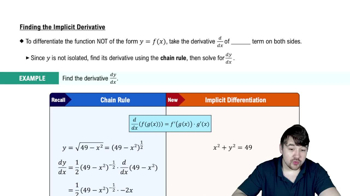
Implicit Differentiation

Implicit differentiation is a technique used to differentiate equations where the dependent variable is not isolated on one side. In this case, we have a relationship between x and y given by sin x cos(y−1) = 1/2. By differentiating both sides with respect to x, we can find dy/dx, which represents y'.
Recommended video:
05:14
Finding The Implicit Derivative

Chain Rule

The chain rule is a fundamental principle in calculus that allows us to differentiate composite functions. When differentiating terms involving y, such as cos(y−1), we apply the chain rule to account for the derivative of the inner function (y−1) with respect to x, which involves dy/dx. This is crucial for correctly finding y'.
Recommended video:
05:02
Intro to the Chain Rule

Trigonometric Identities

Trigonometric identities are equations involving trigonometric functions that hold true for all values of the variables. In this problem, understanding the properties of sine and cosine is essential, especially since we are working with sin x and cos(y−1). These identities can help simplify the expression after differentiation and aid in solving for y'.
Recommended video:
7:17
Verifying Trig Equations as Identities