Ch. 4 - Applications of Derivatives
Hass - Thomas' Calculus 15th Edition
Hass15th EditionThomas' CalculusISBN: 9780137616077Not the one you use?Change textbook
Chapter 4, Problem 4.3.43a

Identifying Extrema


In Exercises 41–52:


a. Identify the function’s local extreme values in the given domain, and say where they occur.


g(x) = x² − 4x + 4, 1 ≤ x < ∞

Verified step by step guidance
1
First, understand that local extrema refer to the local minimum or maximum values of a function within a given domain. For the function g(x) = x² − 4x + 4, we need to find these values within the domain 1 ≤ x < ∞.
To find the local extrema, we start by taking the derivative of the function g(x). The derivative, g'(x), will help us find the critical points where the slope of the tangent is zero or undefined. Calculate the derivative: g'(x) = d/dx (x² − 4x + 4).
Set the derivative equal to zero to find the critical points: g'(x) = 0. Solve the equation to find the values of x where the slope is zero. This will give us potential points for local extrema.
Once you have the critical points, evaluate the second derivative, g''(x), to determine the concavity at these points. If g''(x) > 0, the function has a local minimum at that point. If g''(x) < 0, the function has a local maximum.
Finally, check the critical points within the given domain 1 ≤ x < ∞ to ensure they are valid. Evaluate g(x) at these points to find the local extreme values and specify where they occur.

Verified video answer for a similar problem:

This video solution was recommended by our tutors as helpful for the problem above.
Video duration:
3m
Was this helpful?

Key Concepts

Here are the essential concepts you must grasp in order to answer the question correctly.

Local Extrema

Local extrema refer to the points in a function where it reaches a local maximum or minimum value. These points occur where the derivative of the function is zero or undefined, indicating a change in the direction of the slope. Identifying local extrema involves finding these critical points and using tests like the first or second derivative test to determine their nature.
Recommended video:
05:58
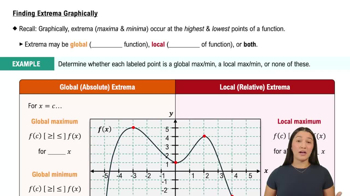
Finding Extrema Graphically

Derivative and Critical Points

The derivative of a function provides the rate of change or slope of the function at any given point. Critical points occur where the derivative is zero or undefined, which are potential locations for local extrema. For the function g(x) = x² − 4x + 4, finding the derivative and setting it to zero helps identify these critical points within the specified domain.
Recommended video:
04:50
Critical Points

Quadratic Functions

Quadratic functions are polynomial functions of degree two, generally expressed in the form ax² + bx + c. They graph as parabolas, which can open upwards or downwards. The vertex of the parabola represents the extremum of the function. For g(x) = x² − 4x + 4, completing the square or using the vertex formula can help find the vertex, which is crucial for identifying the local extremum.
Recommended video:
6:04
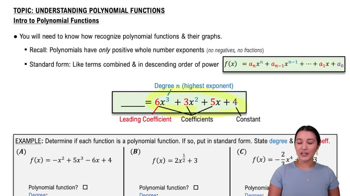
Introduction to Polynomial Functions
Related Practice
Textbook Question

Identifying Extrema


In Exercises 41–52:


a. Identify the function’s local extreme values in the given domain, and say where they occur.


g(x) = −x² − 6x − 9,−4 ≤ x < ∞

160
views

Textbook Question

53. Distance between two ships At noon, ship A was 12 nautical miles due north of ship B. Ship A was sailing south at 12 knots (nautical miles per hour; a nautical mile is 2000 yd) and continued to do so all day. Ship B was sailing east at 8 knots and continued to do so all day.

a. Start counting time with t=0 at noon and express the distance s between the ships as a function of t.

232
views
Textbook Question

Finding Antiderivatives

In Exercises 1–16, find an antiderivative for each function. Do as many as you can mentally. Check your answers by differentiation.

(2/3)x⁻¹ᐟ³

24
views
Textbook Question

Identifying Extrema


In Exercises 41–52:


a. Identify the function’s local extreme values in the given domain, and say where they occur.


f(x) = √(x² − 2x − 3), 3 ≤ x < ∞

152
views
Textbook Question

25. Paper folding A rectangular sheet of 8.5-in.-by-11-in. paper is placed on a flat surface. One of the corners is placed on the opposite longer edge, as shown in the figure, and held there as the paper is smoothed flat. The problem is to make the length of the crease as small as possible. Call the length L. Try it with paper.

" style="" width="370">

a. Show that L^2=2x^3/(2x-8.5).

354
views
Textbook Question

Analyzing Functions from Derivatives


Answer the following questions about the functions whose derivatives are given in Exercises 1–14:


a. What are the critical points of f?


f′(x) = (x − 1)(x + 2)(x − 3)

231
views