Ch. 2 - Limits
Briggs - Calculus: Early Transcendentals 3rd Edition
Briggs3rd EditionCalculus: Early TranscendentalsISBN: 9780136847243Not the one you use?Change textbook
Chapter 2, Problem 2.7.50

Let f(x) =x^2−2x+3.


a. For ε=0.25, find the largest value of δ>0 satisfying the statement


|f(x)−2|<ε whenever 0<|x−1|<δ.

Verified step by step guidance
1
Step 1: Start by understanding the problem. We need to find the largest value of \( \delta > 0 \) such that \( |f(x) - 2| < \varepsilon \) whenever \( 0 < |x - 1| < \delta \). Here, \( f(x) = x^2 - 2x + 3 \) and \( \varepsilon = 0.25 \).
Step 2: Substitute \( f(x) = x^2 - 2x + 3 \) into the inequality \( |f(x) - 2| < 0.25 \). This gives us \( |x^2 - 2x + 3 - 2| < 0.25 \), which simplifies to \( |x^2 - 2x + 1| < 0.25 \).
Step 3: Recognize that \( x^2 - 2x + 1 \) can be rewritten as \( (x - 1)^2 \). Therefore, the inequality becomes \( |(x - 1)^2| < 0.25 \).
Step 4: Since \( |(x - 1)^2| = (x - 1)^2 \) (as squares are always non-negative), we have \( (x - 1)^2 < 0.25 \). Take the square root of both sides to get \( |x - 1| < \sqrt{0.25} \).
Step 5: Calculate \( \sqrt{0.25} \), which is 0.5. Therefore, \( \delta \) can be any value less than or equal to 0.5. The largest value of \( \delta \) satisfying the condition is \( \delta = 0.5 \).

Verified video answer for a similar problem:

This video solution was recommended by our tutors as helpful for the problem above.
Video duration:
3m
Was this helpful?

Key Concepts

Here are the essential concepts you must grasp in order to answer the question correctly.

Limit Definition

The limit definition in calculus describes how a function behaves as it approaches a certain point. In this context, we are interested in the behavior of f(x) as x approaches 1. The statement |f(x)−2|<ε indicates that we want the function's value to be within ε of 2, which is the limit we are examining.
Recommended video:
05:50
One-Sided Limits

Epsilon-Delta Definition of Limit

The epsilon-delta definition formalizes the concept of limits in calculus. It states that for every ε>0, there exists a δ>0 such that if |x−c|<δ, then |f(x)−L|<ε. In this problem, c is 1 and L is 2, meaning we need to find a δ that ensures the function's output remains close to 2 when x is near 1.
Recommended video:
05:50
One-Sided Limits

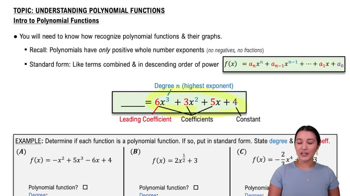
Quadratic Functions

Quadratic functions are polynomial functions of the form f(x) = ax^2 + bx + c. They have a parabolic shape and can be analyzed using their vertex, axis of symmetry, and roots. In this case, f(x) = x^2 - 2x + 3 is a quadratic function, and understanding its graph helps in determining how it behaves around the point x=1.
Recommended video:
6:04
Introduction to Polynomial Functions
Related Practice
Textbook Question

Use the continuity of the absolute value function (Exercise 78) to determine the interval(s) on which the following functions are continuous.


g(x)=x+4x24g\(\left\)(x\(\right\))=\(\left\[\vert\]\frac{x+4}{x^2-4}\[\right\]\vert\)

639
views
Textbook Question

Find the following limits or state that they do not exist. Assume a, b , c, and k are fixed real numbers.


lim x→3 −5x / √4x − 3

237
views
Textbook Question

Find all vertical asymptotes x=ax=a of the following functions. For each value of aa, determine limxa+f(x){\(\displaystyle\]\lim\)_{x\(\to\) a^{+}}}f\(\left\)(x\(\right\)), limxaf(x){\(\displaystyle\]\lim\)_{x\(\to\) a^{-}}}f\(\left\)(x\(\right\)), and limxaf(x){\(\displaystyle\]\lim\)_{x\(\to\) a}}f\(\left\)(x\(\right\)).

f(x)=x+1x34x2+4xf\(\left\)(x\(\right\))=\(\frac{x+1}{x^3-4x^2+4x}\)

347
views
Textbook Question

Let g(x)={x2+xif x<1aif x=13x+5if x>1g\(\left\)(x\(\right\))=\(\begin{cases}\)x^2+x & \(\text{if }\)x<1\\ a & \(\text{if }\)x=1\\ 3x+5 & \(\text{if }\)x>1\(\end{cases}\)

a. Determine the value of a for which gg is continuous from the left at 11.

323
views
Textbook Question

Use the precise definition of a limit to prove the following limits. Specify a relationship between ε and δ that guarantees the limit exists.

lim x→7 f(x)=9, where f(x)={3x−12 if x≤7

x+2 if x>7

365
views
Textbook Question

Determine the end behavior of the following transcendental functions by analyzing appropriate limits. Then provide a simple sketch of the associated graph, showing asymptotes if they exist. 

f(x)=1lnxf\(\left\)(x\(\right\))=1-\(\ln\) x

319
views