Ch. 4 - Applications of Derivatives
Hass - Thomas' Calculus 15th Edition
Hass15th EditionThomas' CalculusISBN: 9780137616077Not the one you use?Change textbook
Chapter 4, Problem 41

Finding Position from Velocity or Acceleration


Exercises 41–44 give the velocity v = ds/dt and initial position of an object moving along a coordinate line. Find the object’s position at time t.


v = 9.8t + 5, s(0) = 10

Verified step by step guidance
1
Start by recognizing that the velocity function v(t) = \(\frac{ds}{dt}\) = 9.8t + 5 is the derivative of the position function s(t). To find the position function, we need to integrate the velocity function with respect to time t.
Set up the integral of the velocity function: \(s(t) = \int (9.8t + 5) \, dt\).
Integrate the function: \(s(t) = \int 9.8t \, dt + \int 5 \, dt\).
Calculate each integral separately: \(\int 9.8t \, dt = 4.9t^2\) and \(\int 5 \, dt = 5t\). Combine these results to get the general form of the position function: \(s(t) = 4.9t^2 + 5t + C\), where C is the constant of integration.
Use the initial condition s(0) = 10 to solve for C. Substitute t = 0 into the position function: \(10 = 4.9(0)^2 + 5(0) + C\). Solve for C to find its value, and then substitute back into the position function to find the specific position function s(t).

Verified video answer for a similar problem:

This video solution was recommended by our tutors as helpful for the problem above.
Video duration:
4m
Was this helpful?

Key Concepts

Here are the essential concepts you must grasp in order to answer the question correctly.

Integration

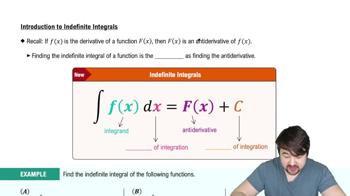
Integration is the process of finding the antiderivative or the area under a curve. In this context, integrating the velocity function v = ds/dt gives the position function s(t). This is because velocity is the derivative of position, so integrating velocity with respect to time will yield the position function.
Recommended video:
05:04
Introduction to Indefinite Integrals

Initial Conditions

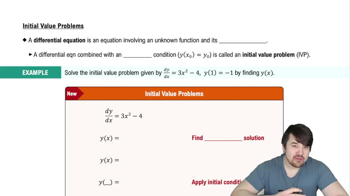
Initial conditions are values that specify the state of a system at a particular time, often used to solve differential equations. Here, s(0) = 10 is the initial position of the object at time t = 0. This information is crucial for determining the constant of integration when finding the position function from the velocity function.
Recommended video:
05:03
Initial Value Problems

Definite and Indefinite Integrals

Indefinite integrals represent a family of functions and include a constant of integration, while definite integrals calculate the area under a curve between two points. In this problem, we use an indefinite integral to find the general form of the position function, and the initial condition helps determine the specific constant, giving the exact position function.
Recommended video:
05:43
Definition of the Definite Integral