
Ch. 1 - Functions
Hass - Thomas' Calculus 15th Edition
Hass15th EditionThomas' CalculusISBN: 9780137616077Not the one you use?Change textbook
Chapter 1, Problem 1.1.3

Functions


In Exercises 1–6, find the domain and range of each function.


F(x) = √(5x + 10)

Verified step by step guidance
1
Step 1: Understand the function F(x) = √(5x + 10). This is a square root function, which means the expression inside the square root must be non-negative for the function to be defined.
Step 2: Set up the inequality for the domain. Since the expression inside the square root must be non-negative, we have 5x + 10 ≥ 0.
Step 3: Solve the inequality 5x + 10 ≥ 0 to find the values of x that satisfy this condition. Subtract 10 from both sides to get 5x ≥ -10.
Step 4: Divide both sides of the inequality by 5 to isolate x, resulting in x ≥ -2. This gives us the domain of the function, which is all x values greater than or equal to -2.
Step 5: Determine the range of the function. Since the square root function outputs non-negative values, the range of F(x) = √(5x + 10) is all non-negative real numbers, starting from 0 and extending to infinity.

Verified video answer for a similar problem:

This video solution was recommended by our tutors as helpful for the problem above.
Video duration:
3m
Was this helpful?

Key Concepts

Here are the essential concepts you must grasp in order to answer the question correctly.

Domain of a Function

The domain of a function refers to the set of all possible input values (x-values) for which the function is defined. For the function F(x) = √(5x + 10), the expression under the square root must be non-negative, which imposes restrictions on x. Thus, determining the domain involves solving the inequality 5x + 10 ≥ 0.
Recommended video:
5:10
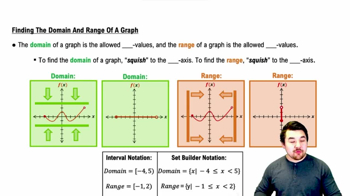
Finding the Domain and Range of a Graph

Range of a Function

The range of a function is the set of all possible output values (y-values) that the function can produce. For F(x) = √(5x + 10), since the square root function only yields non-negative results, the range will start from 0 and extend to positive infinity, depending on the values of x within the domain.
Recommended video:
5:10
Finding the Domain and Range of a Graph

Square Root Function

The square root function, denoted as √x, is defined for non-negative values of x and produces non-negative outputs. It is important to understand that the square root function is not defined for negative inputs, which directly influences both the domain and range of functions that include it, such as F(x) = √(5x + 10).
Recommended video:
7:24
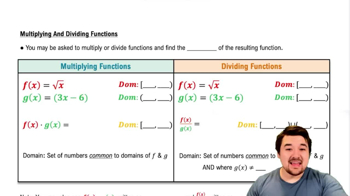
Multiplying & Dividing Functions