Ch. 3 - Derivatives
Briggs - Calculus: Early Transcendentals 3rd Edition
Briggs3rd EditionCalculus: Early TranscendentalsISBN: 9780136847243Not the one you use?Change textbook
Chapter 3, Problem 3.6.3

Complete the following statement. If dy/dx is small, then small changes in x will result in relatively ______ changes in the value of y.

Verified step by step guidance
1
Understand the concept of the derivative: The derivative \( \frac{dy}{dx} \) represents the rate of change of \( y \) with respect to \( x \). It tells us how much \( y \) changes for a small change in \( x \).
Interpret the meaning of a small \( \frac{dy}{dx} \): If \( \frac{dy}{dx} \) is small, it means that the rate of change of \( y \) with respect to \( x \) is small. In other words, \( y \) does not change much as \( x \) changes.
Relate small \( \frac{dy}{dx} \) to changes in \( y \): Since \( \frac{dy}{dx} \) is small, small changes in \( x \) will result in small changes in \( y \). This is because the slope of the tangent line to the curve at that point is shallow.
Visualize the graph: Imagine a graph where the slope of the tangent line is nearly flat. As you move along the \( x \)-axis, the \( y \)-value changes very little, indicating a small change in \( y \).
Complete the statement: Therefore, if \( \frac{dy}{dx} \) is small, then small changes in \( x \) will result in relatively small changes in the value of \( y \).

Verified video answer for a similar problem:

This video solution was recommended by our tutors as helpful for the problem above.
Video duration:
3m
Was this helpful?

Key Concepts

Here are the essential concepts you must grasp in order to answer the question correctly.

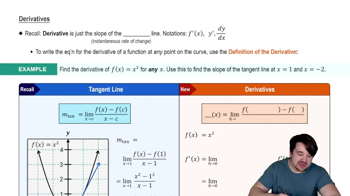
Derivative

The derivative, denoted as dy/dx, represents the rate of change of a function y with respect to a variable x. It quantifies how much y changes for a small change in x, providing insight into the function's behavior at specific points. A small derivative indicates that y changes little when x changes, suggesting a flat slope on the graph of the function.
Recommended video:
05:44
Derivatives

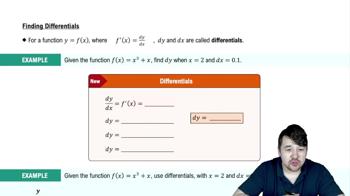
Differential

A differential is an infinitesimal change in a variable, often represented as dy for changes in y and dx for changes in x. In the context of derivatives, it helps to express the relationship between small changes in x and the resulting changes in y. The concept of differentials is crucial for understanding how small variations in input affect output in calculus.
Recommended video:
05:53
Finding Differentials

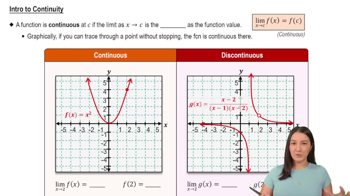
Continuity

Continuity refers to a property of functions where small changes in the input (x) lead to small changes in the output (y). A continuous function does not have abrupt jumps or breaks, ensuring that the behavior of the function is predictable. This concept is essential for understanding the implications of small derivatives, as it guarantees that the relationship between x and y remains stable under small perturbations.
Recommended video:
05:34
Intro to Continuity