Ch. 2 - Limits and Continuity
Hass - Thomas' Calculus 15th Edition
Hass15th EditionThomas' CalculusISBN: 9780137616077Not the one you use?Change textbook
Chapter 2, Problem 3g

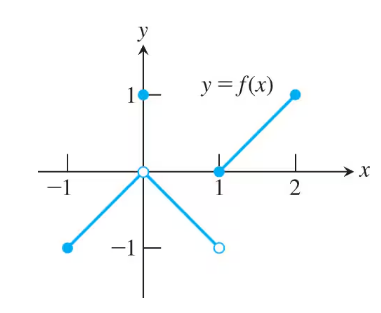
Which of the following statements about the function y=f(x) graphed here are true, and which are false?


g. limx→1 f(x) does not exist.
img

Verified step by step guidance
1
Step 1: Understand the concept of a limit. The limit of a function as x approaches a certain value is the value that the function approaches as x gets closer to that value.
Step 2: To determine if the limit exists at x = 1, examine the behavior of the function f(x) as x approaches 1 from both the left (x → 1⁻) and the right (x → 1⁺).
Step 3: Check if the left-hand limit (lim x→1⁻ f(x)) and the right-hand limit (lim x→1⁺ f(x)) are equal. If they are equal, the limit exists; if not, the limit does not exist.
Step 4: Analyze the graph of the function near x = 1. Look for any discontinuities, jumps, or asymptotic behavior that might indicate the limit does not exist.
Step 5: Conclude whether the limit exists based on the analysis of the graph. If the left-hand and right-hand limits are not equal, then the statement 'lim x→1 f(x) does not exist' is true.

Verified video answer for a similar problem:

This video solution was recommended by our tutors as helpful for the problem above.
Video duration:
3m
Was this helpful?

Key Concepts

Here are the essential concepts you must grasp in order to answer the question correctly.

Limits

A limit is a fundamental concept in calculus that describes the behavior of a function as its input approaches a certain value. It helps determine the value that a function approaches, which may not necessarily be the function's value at that point. Understanding limits is crucial for analyzing continuity, derivatives, and integrals.
Recommended video:
05:50
One-Sided Limits

Continuity

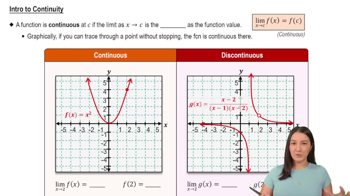
A function is continuous at a point if the limit of the function as it approaches that point equals the function's value at that point. If a function has a discontinuity, it may lead to limits that do not exist. Recognizing points of continuity and discontinuity is essential for evaluating the truth of statements regarding limits.
Recommended video:
05:34
Intro to Continuity

Graphical Analysis

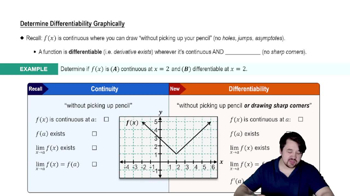
Graphical analysis involves interpreting the visual representation of a function to understand its behavior, including limits, continuity, and asymptotic behavior. By examining the graph, one can identify trends, discontinuities, and the existence of limits at specific points, which is vital for answering questions about the function's properties.
Recommended video:
05:02
Determining Differentiability Graphically