Ch. 4 - Applications of the Derivative
Briggs - Calculus: Early Transcendentals 3rd Edition
Briggs3rd EditionCalculus: Early TranscendentalsISBN: 9780136847243Not the one you use?Change textbook
Chapter 4, Problem 59

Evaluate the following limits in two different ways: with and without l’Hôpital’s Rule.
lim_x→∞ (2x⁵ - x + 1) / (5x⁶ + x)

Verified step by step guidance
1
First, let's evaluate the limit without using l'Hôpital's Rule. Identify the highest power of x in both the numerator and the denominator. In the numerator, the highest power is x^5, and in the denominator, it is x^6.
Divide every term in the numerator and the denominator by x^6, the highest power of x in the denominator. This gives us: (2x^5/x^6 - x/x^6 + 1/x^6) / (5x^6/x^6 + x/x^6).
Simplify the expression: (2/x - 1/x^5 + 1/x^6) / (5 + 1/x^5). As x approaches infinity, terms with x in the denominator approach zero.
Now, evaluate the limit: lim_{x→∞} (2/x - 1/x^5 + 1/x^6) / (5 + 1/x^5) = 0/5 = 0.
Next, let's use l'Hôpital's Rule. Since the limit is in the indeterminate form ∞/∞, differentiate the numerator and the denominator: d/dx(2x^5 - x + 1) = 10x^4 - 1, and d/dx(5x^6 + x) = 30x^5 + 1. Evaluate the new limit: lim_{x→∞} (10x^4 - 1) / (30x^5 + 1). Repeat l'Hôpital's Rule if necessary until the limit is no longer indeterminate.

Verified video answer for a similar problem:

This video solution was recommended by our tutors as helpful for the problem above.
Video duration:
2m
Was this helpful?

Key Concepts

Here are the essential concepts you must grasp in order to answer the question correctly.

Limits

Limits are fundamental in calculus, representing the value that a function approaches as the input approaches a certain point. In this context, we are interested in the limit as x approaches infinity, which helps us understand the behavior of the function at extreme values. Evaluating limits is crucial for determining continuity, derivatives, and integrals.
Recommended video:
05:50
One-Sided Limits

l'Hôpital's Rule

l'Hôpital's Rule is a method for evaluating limits that result in indeterminate forms, such as 0/0 or ∞/∞. It states that if these forms occur, the limit of the ratio of two functions can be found by taking the derivative of the numerator and the derivative of the denominator separately. This rule simplifies the process of finding limits, especially for rational functions.
Recommended video:

Polynomial Growth Rates

Understanding polynomial growth rates is essential for evaluating limits involving polynomials. In the given limit, the degrees of the polynomials in the numerator and denominator determine the limit's value as x approaches infinity. Generally, the term with the highest degree dominates the behavior of the polynomial, allowing for simplification when calculating limits.
Recommended video:
04:16
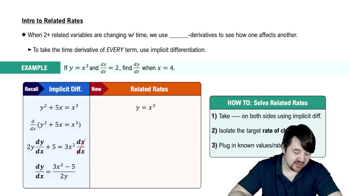
Intro To Related Rates
Related Practice
Textbook Question

Evaluate the following limits. Use l’Hôpital’s Rule when it is convenient and applicable.

lim_x→0⁺ (cot x - 1/x) 

264
views

Textbook Question

{Use of Tech} Modified Newton’s method The function f has a root of multiplicity 2 at r if f(r) = f'(r) = 0 and f"(r) ≠ 0. In this case, a slight modification of Newton’s method, known as the modified (or accelerated) Newton’s method, is given by the formula xₙ + 1 = xₙ - (2f(xₙ)/(f'(xₙ), for n = 0, 1, 2, . . . . This modified form generally increases the rate of convergence.

b. Apply Newton’s method and the modified Newton’s method using x₀ = 0.1 to find the value of x₃ in each case. Compare the accuracy of these values of x₃.

274
views
Textbook Question

Minimizing related functions Complete each of the following parts.

b. What value of x minimizes ƒ(x) = (x- a₁)² + (x - a₂)² + (x - a₃)² , for constants a₁, a₂, and a₃?

258
views
Textbook Question

Verify that the following functions satisfy the conditions of Theorem 4.9 on their domains. Then find the location and value of the absolute extrema guaranteed by the theorem.


f(x) = 4x + 1/√x

257
views
Textbook Question

Evaluate the following limits. Use l’Hôpital’s Rule when it is convenient and applicable.

lim_x→1⁻ (x/(x-1) - x/(ln x) 

219
views
Textbook Question

{Use of Tech} Flow from a tank A cylindrical tank is full at time t=0 when a valve in the bottom of the tank is opened. By Torricelli’s law, the volume of water in the tank after t hours is V=100(200−t)², measured in cubic meters.

c. Find the rate at which water flows from the tank and plot the flow rate function. 

195
views