Ch. 1 - Functions
Briggs - Calculus: Early Transcendentals 3rd Edition
Briggs3rd EditionCalculus: Early TranscendentalsISBN: 9780136847243Not the one you use?Change textbook
Chapter 1, Problem 84

Parabola properties Consider the general quadratic function ƒ(x) = ax² + bx + c , with a ≠ 0.


a. Find the coordinates of the vertex of the graph of the parabola y= ƒ(x)  in terms of a, b, and c.

Verified step by step guidance
1
Step 1: Recognize that the vertex form of a parabola is given by \( y = a(x-h)^2 + k \), where \((h, k)\) is the vertex of the parabola.
Step 2: To find the vertex of the parabola \( y = ax^2 + bx + c \), use the formula for the x-coordinate of the vertex: \( h = -\frac{b}{2a} \).
Step 3: Substitute \( h = -\frac{b}{2a} \) back into the original quadratic function to find the y-coordinate of the vertex: \( k = f\left(-\frac{b}{2a}\right) = a\left(-\frac{b}{2a}\right)^2 + b\left(-\frac{b}{2a}\right) + c \).
Step 4: Simplify the expression for \( k \) to find the y-coordinate of the vertex. This involves calculating \( a\left(-\frac{b}{2a}\right)^2 \), \( b\left(-\frac{b}{2a}\right) \), and adding \( c \).
Step 5: Conclude that the vertex of the parabola \( y = ax^2 + bx + c \) is \( \left(-\frac{b}{2a}, f\left(-\frac{b}{2a}\right)\right) \).

Verified video answer for a similar problem:

This video solution was recommended by our tutors as helpful for the problem above.
Video duration:
5m
Was this helpful?

Key Concepts

Here are the essential concepts you must grasp in order to answer the question correctly.

Quadratic Functions

A quadratic function is a polynomial function of degree two, typically expressed in the form f(x) = ax² + bx + c, where a, b, and c are constants and a ≠ 0. The graph of a quadratic function is a parabola, which can open upwards or downwards depending on the sign of the coefficient 'a'. Understanding the structure of quadratic functions is essential for analyzing their properties, such as the vertex and axis of symmetry.
Recommended video:
6:04
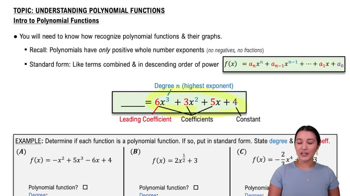
Introduction to Polynomial Functions

Vertex of a Parabola

The vertex of a parabola is the point at which the curve changes direction, representing either the maximum or minimum value of the function. For the quadratic function f(x) = ax² + bx + c, the coordinates of the vertex can be found using the formula (-b/(2a), f(-b/(2a))). This point is crucial for graphing the parabola and understanding its overall shape and behavior.
Recommended video:
7:42
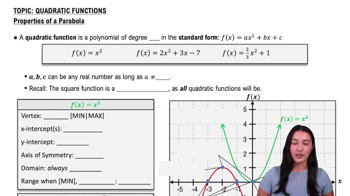
Properties of Parabolas

Axis of Symmetry

The axis of symmetry of a parabola is a vertical line that divides the parabola into two mirror-image halves. For the quadratic function f(x) = ax² + bx + c, the axis of symmetry can be determined using the formula x = -b/(2a). This concept is important for graphing the parabola accurately and helps in identifying the vertex, as the vertex lies on this line.
Recommended video:
06:21
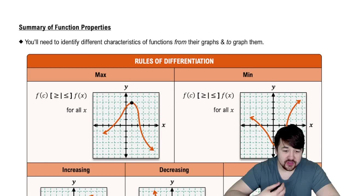
Properties of Functions