Trajectory high point A stone is launched vertically upward from a cliff 192 ft above the ground at a speed of 64 ft/s. Its height above the ground t seconds after the launch is given by s = -16t² + 64t + 192, for 0 ≤ t ≤ 6. When does the stone reach its maximum height?
Verified step by step guidance
1
Identify the function that represents the height of the stone above the ground: \( s(t) = -16t^2 + 64t + 192 \). This is a quadratic function, which represents a parabola.
Recognize that the maximum height of the stone corresponds to the vertex of the parabola. For a quadratic function \( ax^2 + bx + c \), the vertex occurs at \( t = -\frac{b}{2a} \).
Substitute the values of \( a \) and \( b \) from the function \( s(t) = -16t^2 + 64t + 192 \) into the vertex formula: \( a = -16 \) and \( b = 64 \).
Calculate the time \( t \) at which the stone reaches its maximum height using the formula: \( t = -\frac{64}{2(-16)} \).
Verify that the calculated time \( t \) is within the given interval \( 0 \leq t \leq 6 \) to ensure it is a valid solution for the problem.
Verified video answer for a similar problem:
This video solution was recommended by our tutors as helpful for the problem above
Video duration:
2m
Play a video:
0 Comments
Key Concepts
Here are the essential concepts you must grasp in order to answer the question correctly.
Quadratic Functions
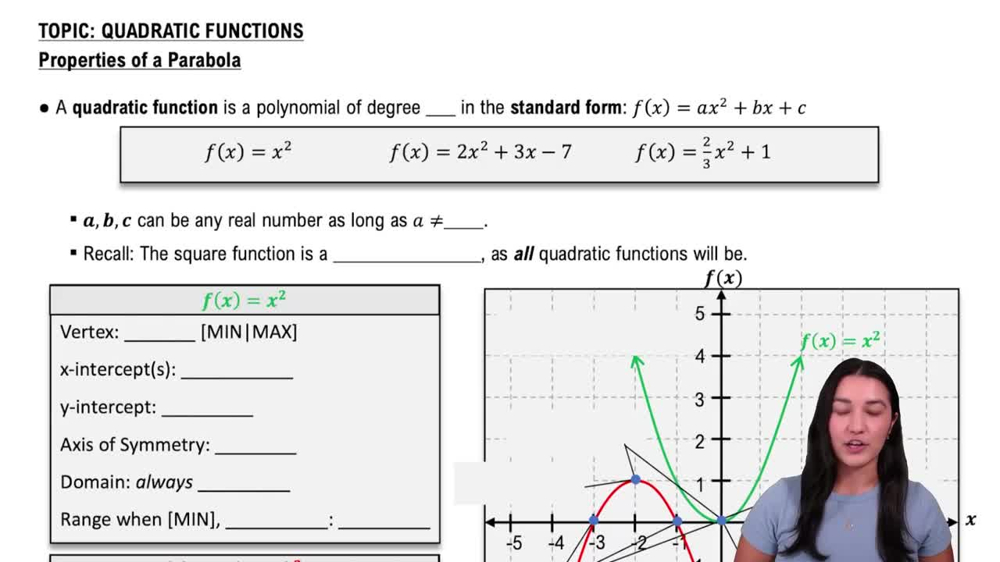
The height of the stone is modeled by a quadratic function, which is a polynomial of degree two. Quadratic functions have a parabolic shape and can be expressed in the form s(t) = at² + bt + c. The coefficients a, b, and c determine the direction and position of the parabola, with 'a' indicating whether it opens upwards or downwards.
The maximum height of the stone corresponds to the vertex of the parabola represented by the quadratic function. For a downward-opening parabola (where a < 0), the vertex can be found using the formula t = -b/(2a). This point gives the time at which the maximum height occurs, which is crucial for solving the problem.
Calculus provides tools for finding maximum and minimum values of functions, which is essential in this context. By taking the derivative of the height function and setting it to zero, we can find critical points that indicate where the maximum height occurs. This process is part of optimization, a key application of calculus in real-world scenarios.