Ch. 2 - Limits
Briggs - Calculus: Early Transcendentals 3rd Edition
Briggs3rd EditionCalculus: Early TranscendentalsISBN: 9780136847243Not the one you use?Change textbook
Chapter 2, Problem 48

Determine the following limits.
lim x→−∞ ex sin x

Verified step by step guidance
1
Recognize that the problem involves finding the limit of the product of two functions as \( x \) approaches \(-\infty\).
Identify the two functions involved: \( e^x \) and \( \sin x \).
Recall that \( e^x \) approaches 0 as \( x \) approaches \(-\infty\).
Note that \( \sin x \) oscillates between -1 and 1 for all real \( x \).
Conclude that the product \( e^x \sin x \) approaches 0 as \( x \) approaches \(-\infty\) because \( e^x \) dominates the behavior of the product by approaching 0.

Verified video answer for a similar problem:

This video solution was recommended by our tutors as helpful for the problem above.
Video duration:
4m
Was this helpful?

Key Concepts

Here are the essential concepts you must grasp in order to answer the question correctly.

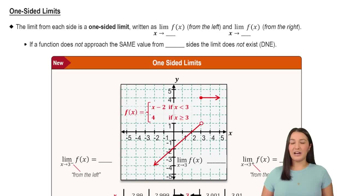
Limits at Infinity

Limits at infinity involve evaluating the behavior of a function as the input approaches positive or negative infinity. Understanding how functions behave in these scenarios is crucial for determining their limits, especially when dealing with exponential and trigonometric functions.
Recommended video:
05:50
One-Sided Limits

Exponential Functions

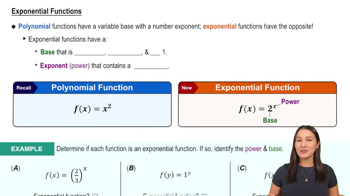
Exponential functions, such as e^x, grow rapidly as x increases and approach zero as x decreases towards negative infinity. This characteristic is essential for analyzing the limit of e^x as x approaches negative infinity, which significantly influences the overall limit of the expression.
Recommended video:
6:13
Exponential Functions

Trigonometric Functions

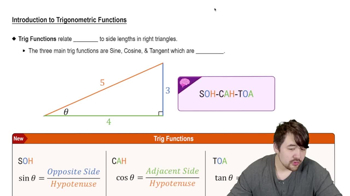
Trigonometric functions like sin(x) oscillate between -1 and 1, regardless of the value of x. This periodic behavior means that while sin(x) does not converge to a single value, its bounded nature plays a critical role in determining the limit of the product e^x sin(x) as x approaches negative infinity.
Recommended video:
6:04
Introduction to Trigonometric Functions