Ch. 3 - Derivatives
Briggs - Calculus: Early Transcendentals 3rd Edition
Briggs3rd EditionCalculus: Early TranscendentalsISBN: 9780136847243Not the one you use?Change textbook
Chapter 3, Problem 72

First and second derivatives Find f′(x),f′′(x).
f(x) = x/x+2

Verified step by step guidance
1
Step 1: Rewrite the function f(x) = \(\frac{x}{x+2}\) in a form suitable for differentiation. This can be done by recognizing it as a quotient of two functions, where the numerator u(x) = x and the denominator v(x) = x + 2.
Step 2: Apply the Quotient Rule for differentiation to find the first derivative f'(x). The Quotient Rule states that if you have a function h(x) = \(\frac{u(x)}{v(x)}\), then h'(x) = \(\frac{u'(x)v(x) - u(x)v'(x)}{(v(x))^2}\).
Step 3: Differentiate the numerator and the denominator separately. For u(x) = x, the derivative u'(x) = 1. For v(x) = x + 2, the derivative v'(x) = 1.
Step 4: Substitute the derivatives u'(x) and v'(x) into the Quotient Rule formula to find f'(x). This gives f'(x) = \(\frac{1 \cdot (x+2) - x \cdot 1}{(x+2)^2}\). Simplify the expression to get the first derivative.
Step 5: To find the second derivative f''(x), differentiate f'(x) with respect to x. This may involve using the Quotient Rule again if f'(x) is still in a quotient form, or using the Power Rule if it simplifies to a polynomial form.

Verified video answer for a similar problem:

This video solution was recommended by our tutors as helpful for the problem above.
Video duration:
7m
Was this helpful?

Key Concepts

Here are the essential concepts you must grasp in order to answer the question correctly.

First Derivative

The first derivative of a function, denoted as f'(x), represents the rate of change of the function with respect to its variable. It provides information about the slope of the tangent line to the curve at any given point. In practical terms, it can indicate whether the function is increasing or decreasing and can help identify critical points where the function may have local maxima or minima.
Recommended video:
07:09
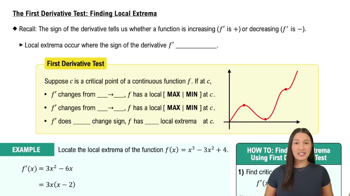
The First Derivative Test: Finding Local Extrema

Second Derivative

The second derivative, denoted as f''(x), is the derivative of the first derivative. It measures the rate of change of the first derivative, providing insights into the concavity of the function. A positive second derivative indicates that the function is concave up (shaped like a cup), while a negative second derivative indicates concave down (shaped like a cap). This information is crucial for understanding the behavior of the function and identifying points of inflection.
Recommended video:
06:02
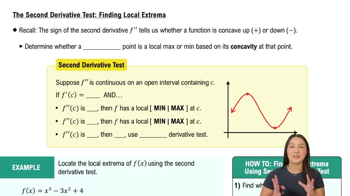
The Second Derivative Test: Finding Local Extrema

Quotient Rule

The quotient rule is a method for finding the derivative of a function that is the ratio of two other functions. If f(x) = g(x)/h(x), the derivative is given by f'(x) = (g'(x)h(x) - g(x)h'(x)) / (h(x))^2. This rule is essential when differentiating functions like f(x) = x/(x+2), as it allows for the correct application of calculus to find both the first and second derivatives.
Recommended video:
06:43
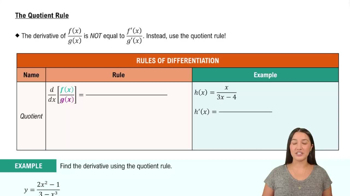
The Quotient Rule
Related Practice
Textbook Question

Find an equation of the line tangent to the following curves at the given value of x.

y = 1+2 sin x; x = π/6

186
views

Textbook Question

Find f′(x), f′′(x), and f′′′(x) for the following functions.

f(x) = (x2 - 7x - 8) / (x + 1)

291
views
Textbook Question

The right-sided and left-sided derivatives of a function at a point aa are given by f+(a)=limh0+f(a+h)f(a)hf_{+}^{\(\prime\)}\(\left\)(a\(\right\))={\(\displaystyle\]\lim\)_{h\(\to\)0^{+}}{\(\frac{f(a+h)-f(a)}{h}\)}} and f(a)=limh0f(a+h)f(a)hf_{-}^{\(\prime\)}\(\left\)(a\(\right\))={\(\displaystyle\]\lim\)_{h\(\to\)0^{-}}{\(\frac{f(a+h)-f(a)}{h}\)}}, respectively, provided these limits exist. The derivative f(a)f^{\(\prime\)}\(\left\)(a\(\right\)) exists if and only if f+(a)=f(a)f_{+}^{\(\prime\)}\(\left\)(a\(\right\))=f_{-}^{\(\prime\)}\(\left\)(a\(\right\)).

Compute f+(a)f_{+}^{\(\prime\)}\(\left\)(a\(\right\)) and f(a)f_{-}^{\(\prime\)}\(\left\)(a\(\right\)) at the given point aa.

f(x)=x2f\(\left\)(x\(\right\))=\(\left\)|x-2\(\right\)|; a=2a=2

260
views
Textbook Question

The following equations implicitly define one or more functions.

c. Use the functions found in part (b) to graph the given equation.

y² = x²(4 − x) / 4 + x (right strophoid)

209
views
Textbook Question

The right-sided and left-sided derivatives of a function at a point aa are given by f+(a)=limh0+f(a+h)f(a)hf_{+}^{\(\prime\)}\(\left\)(a\(\right\))={\(\displaystyle\]\lim\)_{h\(\to\)0^{+}}{\(\frac{f(a+h)-f(a)}{h}\)}} and f(a)=limh0f(a+h)f(a)hf_{-}^{\(\prime\)}\(\left\)(a\(\right\))={\(\displaystyle\]\lim\)_{h\(\to\)0^{-}}{\(\frac{f(a+h)-f(a)}{h}\)}}, respectively, provided these limits exist. The derivative f(a)f^{\(\prime\)}\(\left\)(a\(\right\)) exists if and only if f+(a)=f(a)f_{+}^{\(\prime\)}\(\left\)(a\(\right\))=f_{-}^{\(\prime\)}\(\left\)(a\(\right\)).

Compute f+(a)f_{+}^{\(\prime\)}\(\left\)(a\(\right\)) and f(a)f_{-}^{\(\prime\)}\(\left\)(a\(\right\)) at the given point aa.

f(x)={4x2 if x12x+1 if x>1f(x)=\(\begin{cases}\)4-x^2~\(\text{if}\)~x\(\leq{1}\)\\2x+1~\(\text{if}\)~x\(\gt{1}\]\end{cases}\); a=1a=1

252
views
Textbook Question

Calculate the derivative of the following functions.

y = (p+3)² sin p²

339
views