Ch. 1 - Functions
Briggs - Calculus: Early Transcendentals 3rd Edition
Briggs3rd EditionCalculus: Early TranscendentalsISBN: 9780136847243Not the one you use?Change textbook
Chapter 1, Problem 43

Solve the following equations.
cos3x=sin3x,0x<2π\(\cos\)3x=\(\sin\)3x,0\(\leq{x}\]\lt\)2\(\pi\)

Verified step by step guidance
1
Start by recognizing that the equation \( \cos 3x = \sin 3x \) can be rewritten using the identity \( \tan \theta = \frac{\sin \theta}{\cos \theta} \). This gives us \( \tan 3x = 1 \).
Recall that \( \tan \theta = 1 \) at specific angles. The general solution for \( \tan \theta = 1 \) is \( \theta = \frac{\pi}{4} + n\pi \), where \( n \) is an integer.
Apply this general solution to \( 3x \), giving \( 3x = \frac{\pi}{4} + n\pi \).
Solve for \( x \) by dividing the entire equation by 3: \( x = \frac{\pi}{12} + \frac{n\pi}{3} \).
Determine the values of \( n \) such that \( 0 \leq x < 2\pi \). Substitute different integer values for \( n \) and solve for \( x \) to find all solutions within the given interval.

Verified video answer for a similar problem:

This video solution was recommended by our tutors as helpful for the problem above.
Video duration:
6m
Was this helpful?

Key Concepts

Here are the essential concepts you must grasp in order to answer the question correctly.

Trigonometric Identities

Trigonometric identities are equations that involve trigonometric functions and are true for all values of the variables involved. Key identities include the Pythagorean identity, angle sum and difference identities, and double angle formulas. In this problem, recognizing that \\cos(3x) = \\sin(3x) can be transformed using the identity \\tan(3x) = 1, which simplifies the process of finding solutions.
Recommended video:
7:17
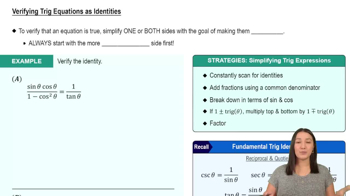
Verifying Trig Equations as Identities

Solving Trigonometric Equations

Solving trigonometric equations involves finding the angles that satisfy the equation within a specified interval. This often requires manipulating the equation to isolate the trigonometric function and then using inverse trigonometric functions or known values. In this case, we need to find values of x such that \\tan(3x) = 1, which leads to specific angles that can be calculated within the given range of 0 to 2π.
Recommended video:
5:02
Solving Logarithmic Equations

Periodic Functions

Periodic functions are functions that repeat their values in regular intervals or periods. The sine and cosine functions are periodic with a period of 2π. When solving the equation \\cos(3x) = \\sin(3x), it is important to consider the periodic nature of these functions, as solutions may occur at multiple angles within the specified interval due to their periodicity, specifically every π/4 radians for this equation.
Recommended video:
6:22
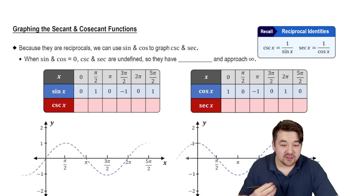
Graphs of Secant and Cosecant Functions