Ch. 3 - Derivatives
Briggs - Calculus: Early Transcendentals 3rd Edition
Briggs3rd EditionCalculus: Early TranscendentalsISBN: 9780136847243Not the one you use?Change textbook
Chapter 3, Problem 3.2.8

If f is continuous at a, must f be differentiable at a?

Verified step by step guidance
1
Step 1: Understand the definitions: A function f is continuous at a point a if the limit of f(x) as x approaches a is equal to f(a). A function is differentiable at a if the derivative f'(a) exists, which means the limit of [f(x) - f(a)] / (x - a) as x approaches a exists.
Step 2: Consider the relationship: Differentiability implies continuity. If a function is differentiable at a point, it must be continuous at that point. However, the reverse is not necessarily true; continuity does not imply differentiability.
Step 3: Explore a counterexample: A classic example is the absolute value function f(x) = |x|. This function is continuous everywhere, including at x = 0, but it is not differentiable at x = 0 because the slope of the tangent line is not defined (the left-hand and right-hand derivatives are not equal).
Step 4: Analyze the counterexample: For f(x) = |x|, as x approaches 0 from the left, the slope of the tangent line approaches -1, and from the right, it approaches 1. Since these two one-sided limits are not equal, the derivative at x = 0 does not exist.
Step 5: Conclude: Therefore, a function can be continuous at a point but not differentiable at that point. Continuity at a point does not guarantee differentiability at that point.

Verified video answer for a similar problem:

This video solution was recommended by our tutors as helpful for the problem above.
Video duration:
6m
Was this helpful?

Key Concepts

Here are the essential concepts you must grasp in order to answer the question correctly.

Continuity

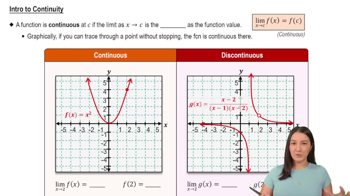
A function f is said to be continuous at a point a if the limit of f as x approaches a equals f(a). This means there are no breaks, jumps, or holes in the graph of the function at that point. Continuity is a fundamental property that ensures the function behaves predictably in the vicinity of a.
Recommended video:
05:34
Intro to Continuity

Differentiability

A function f is differentiable at a point a if the derivative f'(a) exists, which means the function has a defined slope at that point. Differentiability implies that the function is smooth and has no sharp corners or cusps at a. However, a function can be continuous without being differentiable.
Recommended video:
05:53
Finding Differentials

Relationship between Continuity and Differentiability

While every differentiable function is continuous, the converse is not true; a continuous function may not be differentiable at a point. For example, the absolute value function is continuous everywhere but not differentiable at x = 0. Understanding this relationship is crucial for analyzing the behavior of functions in calculus.
Recommended video:
05:34
Intro to Continuity