Ch. 4 - Applications of the Derivative
Briggs - Calculus: Early Transcendentals 3rd Edition
Briggs3rd EditionCalculus: Early TranscendentalsISBN: 9780136847243Not the one you use?Change textbook
Chapter 4, Problem 4.5.5a

Suppose the objective function P= xy is subject to the constraint 10x + y = 100, where x and y are real numbers.


a. Eliminate the variable y from the objective function so that P is expressed as a function of one variable x.

Verified step by step guidance
1
Start with the constraint equation: 10x + y = 100.
Solve the constraint equation for y in terms of x: y = 100 - 10x.
Substitute the expression for y from the constraint into the objective function P = xy.
This substitution gives P = x(100 - 10x).
Simplify the expression to express P as a function of x: P(x) = 100x - 10x^2.

Verified video answer for a similar problem:

This video solution was recommended by our tutors as helpful for the problem above.
Video duration:
1m
Was this helpful?

Key Concepts

Here are the essential concepts you must grasp in order to answer the question correctly.

Objective Function

An objective function is a mathematical expression that defines a quantity to be maximized or minimized, often subject to certain constraints. In this case, the objective function P = xy represents a product of two variables, x and y, which we aim to optimize under the given constraint.
Recommended video:
06:21
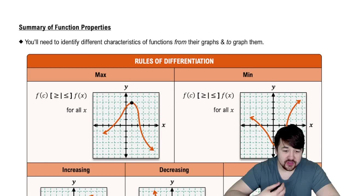
Properties of Functions

Constraints

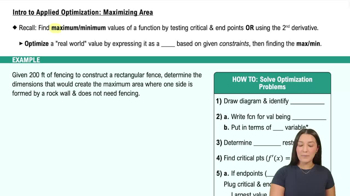
Constraints are conditions or limitations placed on the variables of an optimization problem. Here, the constraint 10x + y = 100 restricts the values that x and y can take, ensuring that any solution must satisfy this linear equation while optimizing the objective function.
Recommended video:
10:13
Intro to Applied Optimization: Maximizing Area

Substitution Method

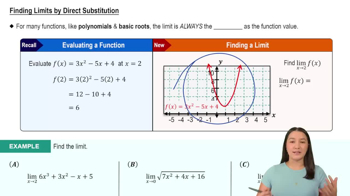
The substitution method involves replacing one variable in an equation with an expression derived from another equation. In this problem, we will use the constraint to express y in terms of x, allowing us to rewrite the objective function P solely in terms of x, simplifying the optimization process.
Recommended video:
05:21
Finding Limits by Direct Substitution
Related Practice
Textbook Question

Explain why or why not Determine whether the following statements are true and give an explanation or counterexample.


a. F(x) = x³ - 4x + 100 and G(x) = x³ - 4x - 100 are antiderivatives of the same function.

52
views

Textbook Question

Folded boxes


a. Squares with sides of length x are cut out of each corner of a rectangular piece of cardboard measuring 5 ft by 8 ft. The resulting piece of cardboard is then folded into a box without a lid. Find the volume of the largest box that can be formed in this way.

319
views
Textbook Question

Optimal soda can


a. Classical problem Find the radius and height of a cylindrical soda can with a volume of 354 cm³ that minimize the surface area.

292
views
Textbook Question

Explain why or why not Determine whether the following statements are true and give an explanation or counterexample.


a. The function f(x) = √x has a local maximum on the interval [0,∞).

234
views
Textbook Question

Maximizing profit Suppose a tour guide has a bus that holds a maximum of 100 people. Assume his profit (in dollars) for taking people on a city tour is P(n) = n(50 - 0.5n) - 100. (Although P is defined only for positive integers, treat it as a continuous function.)


a. How many people should the guide take on a tour to maximize the profit?

342
views
Textbook Question

Population models The population of a species is given by the function P(t) = Kt²/(t² + b) , where t ≥ 0 is measured in years and K and b are positive real numbers.


a. With K = 300 and b = 30, what is lim_t→∞ P(t), the carrying capacity of the population?

333
views