Convert the following expressions to the indicated base.
using base e
Verified step by step guidance
1
Recognize that the expression \(2^x\) needs to be converted to a base \(e\) expression.
Recall the change of base formula: \(a^x = e^{x \ln a}\).
Apply the change of base formula to \(2^x\): \(2^x = e^{x \ln 2}\).
Understand that \(\ln 2\) is the natural logarithm of 2, which is a constant.
Conclude that the expression \(2^x\) in terms of base \(e\) is \(e^{x \ln 2}\).
Verified video answer for a similar problem:
This video solution was recommended by our tutors as helpful for the problem above
Video duration:
1m
Play a video:
0 Comments
Key Concepts
Here are the essential concepts you must grasp in order to answer the question correctly.
Exponential Functions
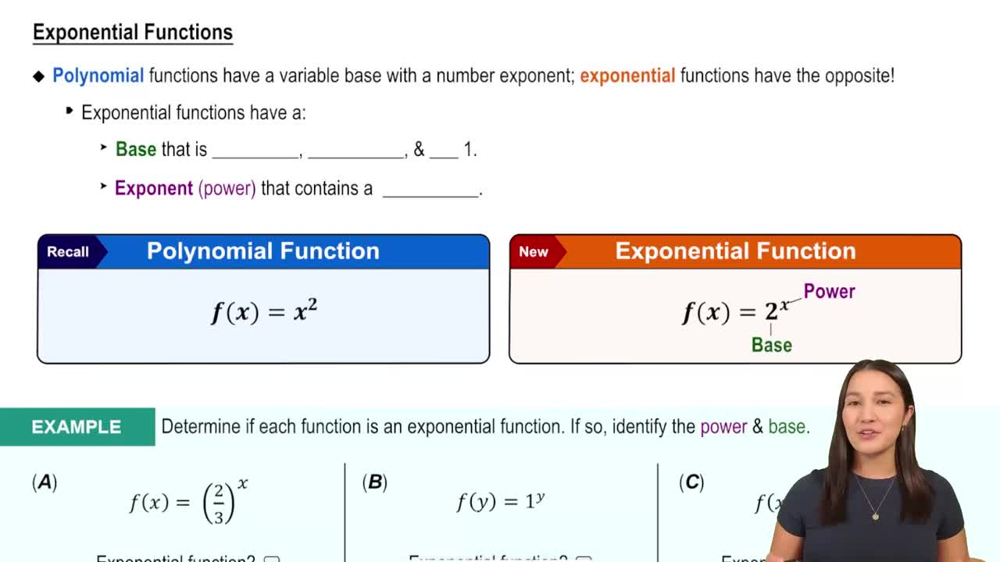
Exponential functions are mathematical expressions in the form of f(x) = a^x, where 'a' is a positive constant and 'x' is a variable. These functions exhibit rapid growth or decay and are characterized by their constant ratio of change. Understanding exponential functions is crucial for converting between different bases, as they form the foundation for many mathematical models in calculus.
The natural logarithm, denoted as ln(x), is the logarithm to the base 'e', where 'e' is approximately equal to 2.71828. It is the inverse function of the exponential function with base 'e'. The natural logarithm is essential for converting expressions from one base to another, particularly when dealing with exponential growth or decay in calculus.
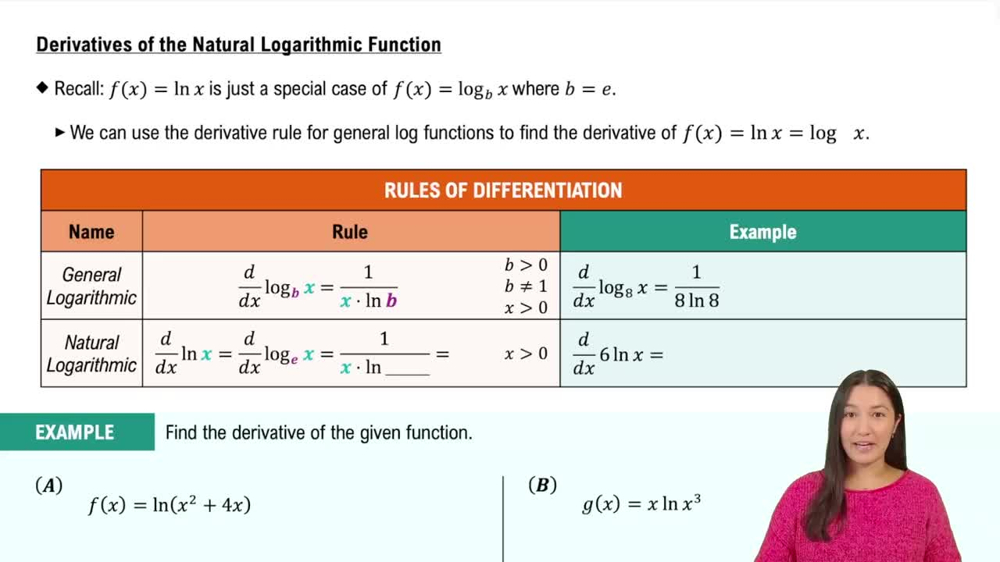
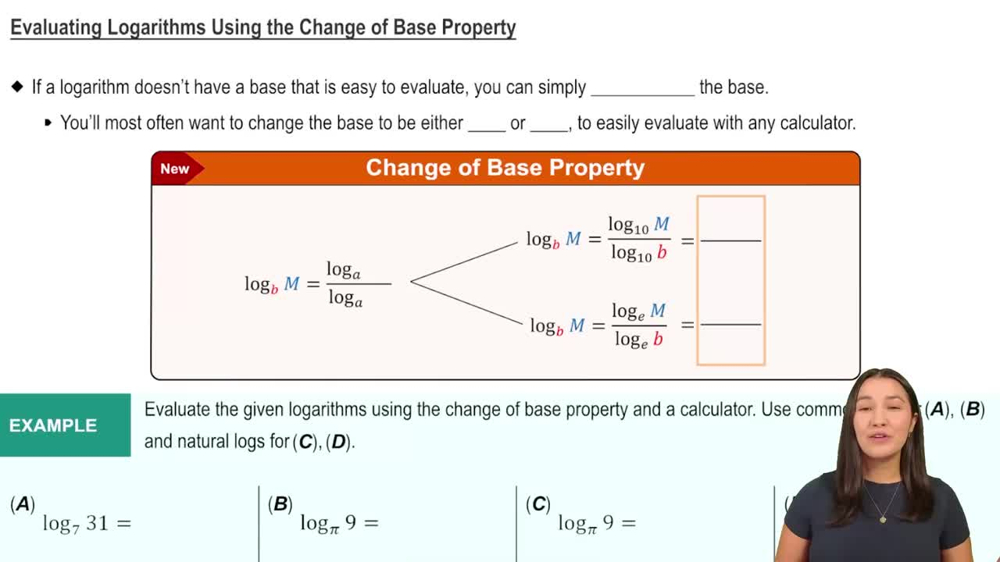
The change of base formula allows for the conversion of logarithms from one base to another. It states that log_b(a) = log_k(a) / log_k(b) for any positive 'k' not equal to 1. This formula is particularly useful when converting exponential expressions, such as 2^x, to a different base like 'e', facilitating easier calculations and comparisons in calculus.

 1:29 minutes
 Verified step by step guidance
 6:13
6:13