Ch. 2 - Limits
Briggs - Calculus: Early Transcendentals 3rd Edition
Briggs3rd EditionCalculus: Early TranscendentalsISBN: 9780136847243Not the one you use?Change textbook
Chapter 2, Problem 2

Evaluate lim x→1 (x^3+3x^2−3x+1).

Verified step by step guidance
1
Identify the type of limit problem: This is a direct substitution problem because the function is a polynomial.
Recall that for polynomial functions, if the function is continuous at the point of interest, you can directly substitute the value of x into the function.
Substitute x = 1 into the polynomial: \(x^3 + 3x^2 - 3x + 1\).
Calculate each term separately: \(1^3\), \(3(1)^2\), \(-3(1)\), and \(+1\).
Add the results of each term to find the limit.

Verified video answer for a similar problem:

This video solution was recommended by our tutors as helpful for the problem above.
Video duration:
1m
Was this helpful?

Key Concepts

Here are the essential concepts you must grasp in order to answer the question correctly.

Limits

A limit is a fundamental concept in calculus that describes the behavior of a function as its input approaches a certain value. In this case, we are interested in the limit of the function as x approaches 1. Understanding limits is crucial for evaluating functions at points where they may not be explicitly defined or for determining their behavior near those points.
Recommended video:
05:50
One-Sided Limits

Polynomial Functions

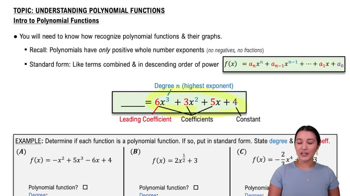
Polynomial functions are expressions that involve variables raised to whole number powers, combined using addition, subtraction, and multiplication. The function in the limit, x^3 + 3x^2 - 3x + 1, is a polynomial. Evaluating limits of polynomial functions is often straightforward, as they are continuous everywhere, allowing us to directly substitute the value of x into the function.
Recommended video:
6:04
Introduction to Polynomial Functions

Continuity

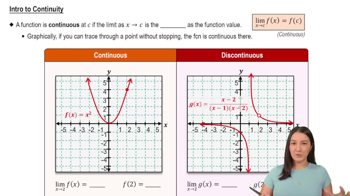
Continuity refers to a property of functions where they do not have any breaks, jumps, or holes in their graphs. A function is continuous at a point if the limit as x approaches that point equals the function's value at that point. Since the polynomial in the limit is continuous at x = 1, we can evaluate the limit by simply substituting x = 1 into the function.
Recommended video:
05:34
Intro to Continuity