Ch. 4 - Applications of the Derivative
Briggs - Calculus: Early Transcendentals 3rd Edition
Briggs3rd EditionCalculus: Early TranscendentalsISBN: 9780136847243Not the one you use?Change textbook
Chapter 4, Problem 4.6.9

Given a function f that is differentiable on its domain, write and explain the relationship between the differentials dx and dy.

Verified step by step guidance
1
Start by understanding that the differential of a function is a concept used to approximate changes in the function's value. For a differentiable function f(x), the differential dy represents the change in the function's output, while dx represents the change in the input.
Recall the definition of the derivative: if f is differentiable at a point x, then the derivative f'(x) is the limit of the ratio of the change in the function to the change in the input as the change in the input approaches zero. Mathematically, this is expressed as: fx.
The relationship between the differentials dx and dy can be expressed using the derivative. If y = f(x), then the differential dy is given by: dy=f'(x)dx. This equation shows that dy is the product of the derivative of f at x and the differential dx.
Understand that the differential dy provides an approximation of the change in the function's value for a small change in x. This approximation becomes more accurate as dx approaches zero.
Finally, remember that differentials are useful in various applications, such as linear approximations and error estimations, where they help in understanding how small changes in input affect the output of a function.

Verified video answer for a similar problem:

This video solution was recommended by our tutors as helpful for the problem above.
Video duration:
1m
Was this helpful?

Key Concepts

Here are the essential concepts you must grasp in order to answer the question correctly.

Differentiation

Differentiation is a fundamental concept in calculus that involves finding the derivative of a function. The derivative represents the rate of change of the function with respect to its variable. It provides a way to understand how a function behaves locally, indicating how small changes in the input (x) affect changes in the output (f(x)).
Recommended video:
05:53
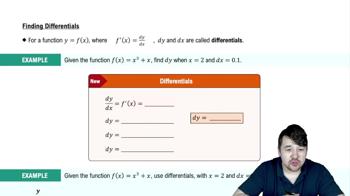
Finding Differentials

Differentials

Differentials are infinitesimally small changes in variables, denoted as dx and dy. In the context of a function f(x), dy represents the change in the function's value resulting from a small change dx in the input variable x. The relationship dy = f'(x)dx illustrates how the differential of the function is proportional to the differential of the input, scaled by the derivative.
Recommended video:
05:53
Finding Differentials

Chain Rule

The Chain Rule is a key principle in calculus that allows us to differentiate composite functions. It states that if a function y = f(g(x)) is composed of two functions, the derivative can be found by multiplying the derivative of the outer function f with the derivative of the inner function g. This rule is essential for understanding how changes in one variable affect another through a chain of relationships.
Recommended video:
05:02
Intro to the Chain Rule
Related Practice
Textbook Question

23–68. Indefinite integrals Determine the following indefinite integrals. Check your work by differentiation.


∫ (sec² Θ + sec Θ tan Θ)dΘ

105
views

Textbook Question

Evaluate the following limits. Use l’Hôpital’s Rule when it is convenient and applicable.

lim_x→ e (ln x - 1) / (x - 1)

301
views
Textbook Question

Avalanche forecasting Avalanche forecasters measure the temperature gradient dT/dh, which is the rate at which the temperature in a snowpack T changes with respect to its depth h. A large temperature gradient may lead to a weak layer in the snowpack. When these weak layers collapse, avalanches occur. Avalanche forecasters use the following rule of thumb: If dT/dh exceeds 10° C/m anywhere in the snowpack, conditions are favorable for weak-layer formation, and the risk of avalanche increases. Assume the temperature function is continuous and differentiable.


a. An avalanche forecaster digs a snow pit and takes two temperature measurements. At the surface (h = 0), the temperature is -16° C. At a depth of 1.1 m, the temperature is -2° C. Using the Mean Value Theorem, what can he conclude about the temperature gradient? Is the formation of a weak layer likely?

176
views
Textbook Question

Graphing functions Use the guidelines of this section to make a complete graph of f.


f(x) = 1/(e⁻ˣ - 1)

160
views
Textbook Question

Increasing and decreasing functions. Find the intervals on which f is increasing and the intervals on which it is decreasing.


f(x) = x⁴/4 - 8x³/3 + 15x²/2 + 8

270
views
Textbook Question

Locating critical points Find the critical points of the following functions. Assume a is a nonzero constant.


ƒ(x) = eˣ + e⁻ˣ

213
views