Ch. 2 - Limits
Briggs - Calculus: Early Transcendentals 3rd Edition
Briggs3rd EditionCalculus: Early TranscendentalsISBN: 9780136847243Not the one you use?Change textbook
Chapter 2, Problem 6b

Estimate lim θ→0 sin 2θ / sin θ using the graph in part (a).

Verified step by step guidance
1
Step 1: Understand the problem. We need to estimate the limit of the function \( \frac{\sin 2\theta}{\sin \theta} \) as \( \theta \) approaches 0.
Step 2: Recall the double angle identity for sine, which states \( \sin 2\theta = 2 \sin \theta \cos \theta \).
Step 3: Substitute the double angle identity into the original expression: \( \frac{2 \sin \theta \cos \theta}{\sin \theta} \).
Step 4: Simplify the expression by canceling out \( \sin \theta \) in the numerator and denominator, resulting in \( 2 \cos \theta \).
Step 5: Evaluate the limit of \( 2 \cos \theta \) as \( \theta \) approaches 0.

Verified video answer for a similar problem:

This video solution was recommended by our tutors as helpful for the problem above.
Video duration:
1m
Was this helpful?

Key Concepts

Here are the essential concepts you must grasp in order to answer the question correctly.

Limit of a Function

The limit of a function describes the value that a function approaches as the input approaches a certain point. In this case, we are interested in the behavior of the function sin(2θ)/sin(θ) as θ approaches 0. Understanding limits is fundamental in calculus, as it lays the groundwork for concepts like continuity and derivatives.
Recommended video:
06:11
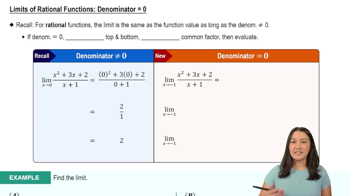
Limits of Rational Functions: Denominator = 0

Sine Function Behavior

The sine function, sin(θ), is a periodic function that oscillates between -1 and 1. Near θ = 0, sin(θ) can be approximated by its Taylor series expansion, where sin(θ) ≈ θ. This approximation is crucial for evaluating limits involving sine functions, especially when the angle approaches zero.
Recommended video:
5:53
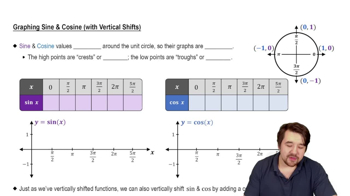
Graph of Sine and Cosine Function

L'Hôpital's Rule

L'Hôpital's Rule is a method for evaluating limits of indeterminate forms, such as 0/0 or ∞/∞. It states that if the limit of f(θ)/g(θ) results in an indeterminate form, the limit can be found by taking the derivative of the numerator and the derivative of the denominator. This rule can simplify the process of finding limits involving trigonometric functions.
Recommended video: