Ch. 2 - Limits and Continuity
Hass - Thomas' Calculus 15th Edition
Hass15th EditionThomas' CalculusISBN: 9780137616077Not the one you use?Change textbook
Chapter 2, Problem 32

Continuous Extension


Explain why the function Ζ’(𝓍) = sin(1/𝓍) has no continuous extension to 𝓍 = 0.

Verified step by step guidance
1
To understand why the function Ζ’(𝓍) = sin(1/𝓍) has no continuous extension to 𝓍 = 0, we first need to consider the behavior of the function as 𝓍 approaches 0. The function is defined for all 𝓍 β‰  0, but we are interested in its behavior as 𝓍 gets very close to 0.
As 𝓍 approaches 0, the expression 1/𝓍 becomes very large in magnitude, which means that the argument of the sine function oscillates rapidly between positive and negative values. This rapid oscillation causes the function Ζ’(𝓍) = sin(1/𝓍) to oscillate between -1 and 1 without settling down to any particular value.
For a function to have a continuous extension at a point, the limit of the function as it approaches that point must exist and be finite. In this case, we need to check if the limit of Ζ’(𝓍) as 𝓍 approaches 0 exists.
To determine the limit, consider the fact that for any sequence of values of 𝓍 approaching 0, the corresponding sequence of values of 1/𝓍 will cover all real numbers densely. This means that the values of sin(1/𝓍) will cover the interval [-1, 1] densely as well, without converging to a single value.
Since the limit of Ζ’(𝓍) as 𝓍 approaches 0 does not exist (the function does not approach a single value), there is no way to define Ζ’(0) such that the function becomes continuous at 𝓍 = 0. Therefore, Ζ’(𝓍) = sin(1/𝓍) has no continuous extension to 𝓍 = 0.

Verified video answer for a similar problem:

This video solution was recommended by our tutors as helpful for the problem above.
Video duration:
6m
Was this helpful?

Key Concepts

Here are the essential concepts you must grasp in order to answer the question correctly.

Limits

Limits are fundamental in calculus, representing the value that a function approaches as the input approaches a certain point. For the function Ζ’(𝓍) = sin(1/𝓍), we need to analyze the limit as 𝓍 approaches 0. If the limit does not exist or is not finite, the function cannot be continuously extended to that point.
Recommended video:
05:50
One-Sided Limits

Continuity

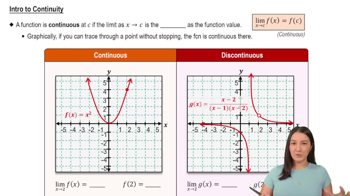
A function is continuous at a point if the limit of the function as it approaches that point equals the function's value at that point. For Ζ’(𝓍) = sin(1/𝓍}, we find that as 𝓍 approaches 0, the function oscillates between -1 and 1, indicating that it does not settle at a single value, thus failing the continuity requirement at 𝓍 = 0.
Recommended video:
05:34
Intro to Continuity

Oscillation

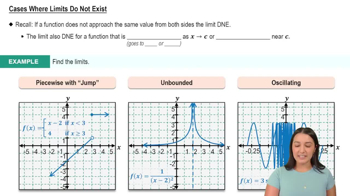
Oscillation refers to the behavior of a function that fluctuates between values without converging to a single limit. In the case of Ζ’(𝓍) = sin(1/𝓍), as 𝓍 approaches 0, the function oscillates infinitely between -1 and 1, which means it does not approach any specific value, preventing a continuous extension to 𝓍 = 0.
Recommended video:
03:07
Cases Where Limits Do Not Exist
Related Practice
Textbook Question

Find the limits in Exercises 49–52. Write ∞ or βˆ’βˆž where appropriate.


lim xβ†’(βˆ’Ο€/2)⁺ sec x

226
views
Textbook Question

[Technology Exercise] Roots


Let Ζ’(𝓍) = 𝓍³ ―𝓍― 1.


b. Solve the equation Ζ’(𝓍) = 0 graphically with an error of magnitude at most 10⁻⁸ .

175
views
Textbook Question

Find the limits in Exercises 49–52. Write ∞ or βˆ’βˆž where appropriate.


lim ΞΈβ†’0 (2 βˆ’ cot ΞΈ)

238
views
Textbook Question

Finding Deltas Algebraically


Each of Exercises 15–30 gives a function f(x) and numbers L, c, and Ξ΅>0. In each case, find the largest open interval about c on which the inequality |f(x)βˆ’L| <Ξ΅ holds. Then give a value for Ξ΄>0 such that for all x satisfying 0 < |xβˆ’c| < Ξ΄, the inequality |f(x)βˆ’L| < Ξ΅ holds.


f(x) = mx, m > 0, L = 2m, c = 2, Ξ΅ = 0.03

306
views
Textbook Question

[Technology Exercise] Roots


Let Ζ’(𝓍) = 𝓍³ ―𝓍― 1.


c. It can be shown that the exact value of the solution in part (b) is


(1/2 + √69/18)ΒΉ/Β³ + (1/2 ― √69/18)ΒΉ/Β³


Evaluate this exact answer and compare it with the value you found in part (b).

168
views
Textbook Question

[Technology Exercise] In Exercises 33–36, graph the function to see whether it appears to have a continuous extension to the given point a. If it does, use Trace and Zoom to find a good candidate for the extended function’s value at a. If the function does not appear to have a continuous extension, can it be extended to be continuous from the right or left? If so, what do you think the extended function’s value should be?


g(ΞΈ) = 5 cos ΞΈ / (4ΞΈ ― 2Ο€) , a = Ο€/2

248
views