Step 1: Understand the notation: The expression \( \lim_{x \to a} f(x) = \infty \) is a way to describe the behavior of a function \( f(x) \) as the variable \( x \) approaches a specific value \( a \).
Step 2: Interpret the meaning: This notation means that as \( x \) gets closer and closer to \( a \), the values of \( f(x) \) increase without bound. In other words, \( f(x) \) becomes arbitrarily large.
Step 3: Consider the context: This type of limit is often used to describe vertical asymptotes in graphs, where the function grows indefinitely as it approaches a certain point.
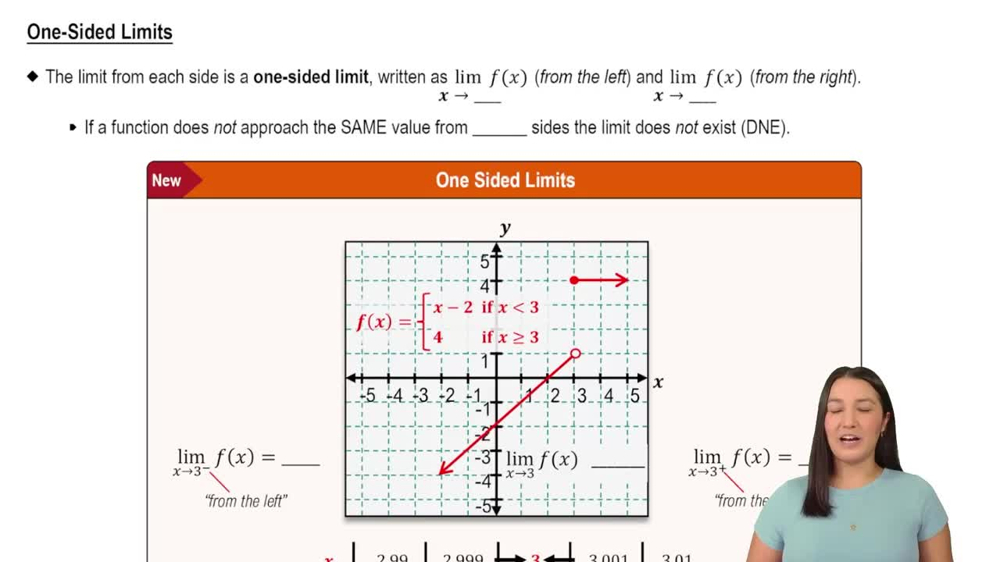
Step 4: Visualize the concept: Imagine a graph where as you move along the x-axis towards \( a \), the y-values (outputs of \( f(x) \)) shoot upwards towards infinity, never settling at a finite number.
Step 5: Relate to real-world examples: Think of scenarios like the speed of an object approaching the speed of light, where the energy required becomes infinitely large as the speed approaches a certain limit.
Verified video answer for a similar problem:
This video solution was recommended by our tutors as helpful for the problem above
Video duration:
2m
Play a video:
0 Comments
Key Concepts
Here are the essential concepts you must grasp in order to answer the question correctly.
Limit of a Function
The limit of a function describes the behavior of that function as the input approaches a certain value. Specifically, lim x→a f(x) indicates the value that f(x) approaches as x gets infinitely close to a. Understanding limits is fundamental in calculus, as they form the basis for defining continuity, derivatives, and integrals.
An infinite limit occurs when the value of a function increases without bound as the input approaches a specific point. In the expression lim x→a f(x) = ∞, it signifies that as x approaches 'a', the function f(x) grows larger and larger, indicating that it does not settle at a finite value. This concept is crucial for analyzing vertical asymptotes in graphs.
Vertical asymptotes are lines that a graph approaches but never touches or crosses, typically occurring at points where a function tends toward infinity. When lim x→a f(x) = ∞, it suggests that there is a vertical asymptote at x = a, indicating a significant change in the function's behavior near that point. Recognizing vertical asymptotes helps in understanding the overall shape and limits of functions.

 2:46 minutes
 Verified step by step guidance
 06:11
06:11