Ch. 1 - Functions
Briggs - Calculus: Early Transcendentals 3rd Edition
Briggs3rd EditionCalculus: Early TranscendentalsISBN: 9780136847243Not the one you use?Change textbook
Chapter 1, Problem 112a

Daylight function for 40 °N Verify that the function D(t)=2.8sin(2π365(t81))+12D(t)=2.8\(\sin\)(\(\frac{2\pi}{365}\)(t-81))+12 has the following properties, where t is measured in days and D is the number of hours between sunrise and sunset. It has a period of 365 days.

Verified step by step guidance
1
Identify the general form of a sinusoidal function, which is typically given by A \(\sin\)(B(t - C)) + D, where A is the amplitude, B affects the period, C is the phase shift, and D is the vertical shift.
In the given function D(t) = 2.8 \(\sin\)\(\left\)(\(\frac{2\pi}{365}\)(t-81)\(\right\)) + 12, compare it to the general form to identify the values of A, B, C, and D. Here, A = 2.8, B = \(\frac{2\pi}{365}\), C = 81, and D = 12.
The period of a sinusoidal function is determined by the coefficient B in front of t. The formula for the period is \(\frac{2\pi}{B}\).
Substitute B = \(\frac{2\pi}{365}\) into the period formula: \(\text{Period}\) = \(\frac{2\pi}{\frac{2\pi}{365}\)}.
Simplify the expression for the period to verify that it equals 365 days, confirming that the function has the desired period.

Verified video answer for a similar problem:

This video solution was recommended by our tutors as helpful for the problem above.
Video duration:
3m
Was this helpful?

Key Concepts

Here are the essential concepts you must grasp in order to answer the question correctly.

Trigonometric Functions

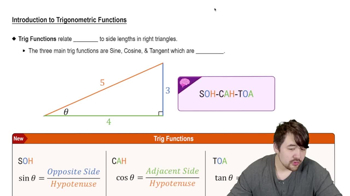
Trigonometric functions, such as sine and cosine, are fundamental in calculus and describe relationships between angles and sides of triangles. In the context of periodic phenomena, like daylight hours, the sine function models the cyclical nature of these changes over time, allowing us to predict values based on the angle of the input.
Recommended video:
6:04
Introduction to Trigonometric Functions

Periodicity

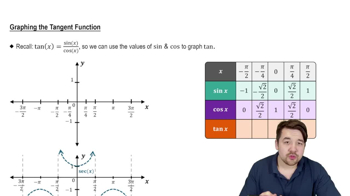
Periodicity refers to the repeating nature of a function over a specific interval. In this case, the function D(t) has a period of 365 days, meaning it repeats its values every year. Understanding periodicity is crucial for analyzing functions that model seasonal or cyclical behaviors, such as daylight duration throughout the year.
Recommended video:
5:43
Introduction to Tangent Graph

Phase Shift

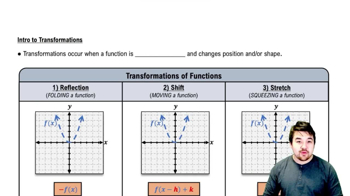
Phase shift is a horizontal shift in the graph of a periodic function, affecting where the cycle begins. In the function D(t), the term (t - 81) indicates a phase shift, which adjusts the starting point of the sine wave. This is important for accurately modeling real-world phenomena, such as when daylight hours begin to increase or decrease throughout the year.
Recommended video:
5:25
Intro to Transformations
Related Practice
Textbook Question

Daylight function for 40 °N Verify that the function D(t)=2.8sin(2π365(t81))+12D(t)=2.8\(\sin\)(\(\frac{2\pi}{365}\)(t-81))+12 has the following properties, where t is measured in days and D is the number of hours between sunrise and sunset.


D(81)=12D(81) = 12 and D(264)12D(264) ≈ 12  (corresponding to the equinoxes).

545
views

Textbook Question

Design a sine function with the given properties.

It has a period of 1212 with a minimum value of 4-4 at t=0t=0 and a maximum value of 44 at t=6t=6.

337
views
Textbook Question

Daylight function for 40 °N Verify that the function D(t)=2.8sin(2π365(t81))+12D(t)=2.8\(\sin\)(\(\frac{2\pi}{365}\)(t-81))+12 has the following properties, where t is measured in days and D is the number of hours between sunrise and sunset.


Its maximum and minimum values are 14.8 and 9.2, respectively, which occur approximately at t=172t= 172  and t=355t = 355, respectively (corresponding to the solstices).

527
views
Textbook Question

{Use of Tech} Triple intersection Graph the functions f(x) = x³,g(x)=3^x, and h(x)=x^x and find their common intersection point (exactly).

368
views
Textbook Question

Beginning with the graphs of y=sinxy=\(\sin\) x or y=cosxy=\(\cos\) x, use shifting and scaling transformations to sketch the graph of the following functions. Use a graphing utility to check your work.

q(x)=3.6cos(πx24)+2q\(\left\)(x\(\right\))=3.6\(\cos\[\left\)(\(\frac{\pi x}{24}\]\right\))+2

257
views