
Observers at positions A and B 2 km apart simultaneously measure the angle of elevation of a weather balloon to be 40° and 70°, respectively. If the balloon is directly above a point on the line segment between A and B, find the height of the balloon.
Ch. 1 - Functions
Chapter 1, Problem 68
In Exercises 65–68, ABC is a right triangle with the right angle at C. The sides opposite angles A, B, and C are a, b, and c, respectively.
a. Express sin A in terms of a and c.
b. Express sin A in terms of b and c.
Verified step by step guidance1
Step 1: Understand the problem setup. We have a right triangle ABC with the right angle at C. The sides opposite angles A, B, and C are labeled as a, b, and c, respectively. In a right triangle, the side opposite the right angle is the hypotenuse, which is c in this case.
Step 2: Recall the definition of the sine function in a right triangle. The sine of an angle is defined as the ratio of the length of the side opposite the angle to the length of the hypotenuse.
Step 3: To express sin A in terms of a and c, use the definition of sine. Since angle A is opposite side a and the hypotenuse is c, we have:
Step 4: To express sin A in terms of b and c, we need to use the Pythagorean identity. In a right triangle, the square of the hypotenuse (c) is equal to the sum of the squares of the other two sides (a and b). Therefore, . Solve for a:
Step 5: Substitute the expression for a from Step 4 into the sine formula from Step 3 to express sin A in terms of b and c:

Verified video answer for a similar problem:
This video solution was recommended by our tutors as helpful for the problem above.
Video duration:
2mWas this helpful?
Key Concepts
Here are the essential concepts you must grasp in order to answer the question correctly.
Sine Function
The sine function is a fundamental trigonometric function defined for a right triangle as the ratio of the length of the side opposite an angle to the length of the hypotenuse. For angle A in triangle ABC, sin A = opposite/hypotenuse = a/c, where 'a' is the side opposite angle A and 'c' is the hypotenuse.
Recommended video:
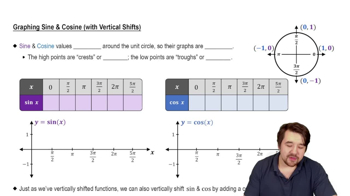
Graph of Sine and Cosine Function
Right Triangle Properties
In a right triangle, the relationship between the angles and sides is governed by the Pythagorean theorem and trigonometric ratios. The right angle (90 degrees) allows for the use of sine, cosine, and tangent to relate the angles to the lengths of the sides, which is essential for solving problems involving right triangles.
Recommended video:
Properties of Functions
Trigonometric Ratios
Trigonometric ratios are the ratios of the lengths of sides of a right triangle relative to its angles. These ratios (sine, cosine, tangent) are used to express relationships between the angles and sides, allowing for the calculation of unknown lengths or angles in triangle ABC, particularly in expressing sin A in terms of different sides.
Recommended video:
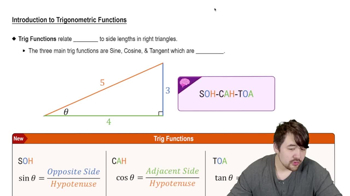
Introduction to Trigonometric Functions
Related Practice
Textbook Question
233
views
Textbook Question
Two wires stretch from the top T of a vertical pole to points B and C on the ground, where C is 10 m closer to the base of the pole than is B. If wire BT makes an angle of 35° with the horizontal and wire CT makes an angle of 50° with the horizontal, how high is the pole?
233
views
Textbook Question
A triangle has side c = 2 and angles A = π/4 and B = π/3. Find the length a of the side opposite A.
214
views
Textbook Question
In Exercises 65–68, ABC is a right triangle with the right angle at C. The sides opposite angles A, B, and C are a, b, and c, respectively.
a. Find a and b if c = 2, B = π/3.
b. Find a and c if b = 2, B = π/3.
306
views
Textbook Question
In Exercises 59–62, sketch the graph of the given function. What is the period of the function?
𝔂 = cos πx/2
212
views
