Ch. 3 - Derivatives
Briggs - Calculus: Early Transcendentals 3rd Edition
Briggs3rd EditionCalculus: Early TranscendentalsISBN: 9780136847243Not the one you use?Change textbook
Chapter 3, Problem 3.R.32

9–61. Evaluate and simplify y'.


y = csc⁵ 3x

Verified step by step guidance
1
First, recognize that the problem involves differentiating a function. We need to find the derivative of y with respect to x, denoted as y'.
The given function is y = csc⁵(3x). To differentiate this, apply the chain rule. The chain rule states that if you have a composite function f(g(x)), the derivative is f'(g(x)) * g'(x).
Identify the outer function as f(u) = u⁵, where u = csc(3x). The derivative of u⁵ with respect to u is 5u⁴.
Next, differentiate the inner function u = csc(3x). The derivative of csc(x) is -csc(x)cot(x), so the derivative of csc(3x) is -csc(3x)cot(3x) * 3, using the chain rule again.
Combine these results using the chain rule: y' = 5(csc(3x))⁴ * (-csc(3x)cot(3x) * 3). Simplify the expression by multiplying the constants and combining like terms.

Verified video answer for a similar problem:

This video solution was recommended by our tutors as helpful for the problem above.
Video duration:
3m
Was this helpful?

Key Concepts

Here are the essential concepts you must grasp in order to answer the question correctly.

Differentiation

Differentiation is a fundamental concept in calculus that involves finding the derivative of a function. The derivative represents the rate of change of the function with respect to its variable. In this case, we need to differentiate the function y = csc⁵(3x) to find y'.
Recommended video:
05:53
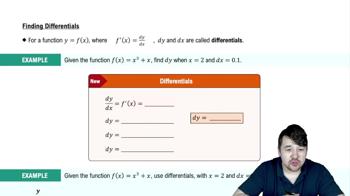
Finding Differentials

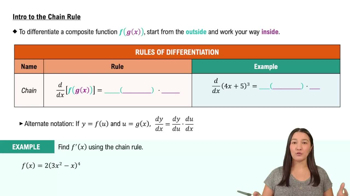
Chain Rule

The Chain Rule is a technique used in differentiation when dealing with composite functions. It states that the derivative of a composite function is the derivative of the outer function evaluated at the inner function, multiplied by the derivative of the inner function. For y = csc⁵(3x), applying the Chain Rule is essential to correctly differentiate the function.
Recommended video:
05:02
Intro to the Chain Rule

Trigonometric Derivatives

Trigonometric derivatives are the derivatives of trigonometric functions, which have specific rules. For example, the derivative of csc(x) is -csc(x)cot(x). Understanding these rules is crucial for differentiating y = csc⁵(3x), as we will need to apply the derivative of the csc function in our calculations.
Recommended video:
06:35
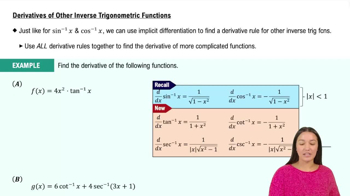
Derivatives of Other Inverse Trigonometric Functions