
Textbook Question
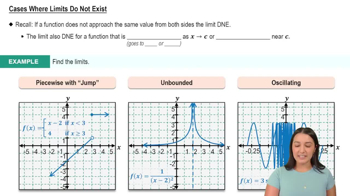
If f(1)=5, must limx→1 f(x) exist? If it does, then must limx→1 f(x)=5? Can we conclude anything about limx→1 f(x)? Explain.
361
views

 Verified step by step guidance
 03:07
03:07
 6:04
6:04 05:03
05:03If f(1)=5, must limx→1 f(x) exist? If it does, then must limx→1 f(x)=5? Can we conclude anything about limx→1 f(x)? Explain.
Using limθ→0 sin θ / θ = 1
Find the limits in Exercises 23–46.
llimx→0 (x −x cos x) / sin² 3x
In Exercises 1–4, say whether the function graphed is continuous on [−1, 3]. If not, where does it fail to be continuous and why?
<IMAGE>
Using the Formal Definition
Each of Exercises 31–36 gives a function f(x), a point c, and a positive number ε. Find L = lim x→c f(x). Then find a number δ > 0 such that |f(x)−L| < ε whenever 0 < |x−c| < δ.
f(x) = −3x − 2, c = −1, ε = 0.03
Horizontal and Vertical Asymptotes
Assume that constants a and b are positive. Find equations for all horizontal and vertical asymptotes for the graph of y = (√ax² + 4) / (x―b) .
Slope of a Curve at a Point
In Exercises 7–18, use the method in Example 3 to find (a) the slope of the curve at the given point P, and (b) an equation of the tangent line at P.
y=7−x², P(2,3)