Ch. 1 - Functions
Briggs - Calculus: Early Transcendentals 3rd Edition
Briggs3rd EditionCalculus: Early TranscendentalsISBN: 9780136847243Not the one you use?Change textbook
Chapter 1, Problem 1.43

Working with composite functions
Find possible choices for outer and inner functions ƒ and g such that the given function h equals ƒ o g.
h(x) = (x³ - 5)¹⁰

Verified step by step guidance
1
Step 1: Identify the structure of the composite function. The given function is \( h(x) = (x^3 - 5)^{10} \). This suggests that there is an inner function and an outer function involved.
Step 2: Determine the inner function \( g(x) \). Look for a function inside another function. Here, \( g(x) = x^3 - 5 \) is a natural choice for the inner function because it is the expression inside the power.
Step 3: Determine the outer function \( f(u) \). The outer function is applied to the result of the inner function. In this case, \( f(u) = u^{10} \) is the outer function, where \( u = g(x) = x^3 - 5 \).
Step 4: Verify the composition. Check that \( f(g(x)) = f(x^3 - 5) = (x^3 - 5)^{10} \) matches the original function \( h(x) \).
Step 5: Conclude the choices. The functions \( f(u) = u^{10} \) and \( g(x) = x^3 - 5 \) are valid choices for the outer and inner functions, respectively, such that \( h(x) = f(g(x)) \).

Verified video answer for a similar problem:

This video solution was recommended by our tutors as helpful for the problem above.
Video duration:
1m
Was this helpful?

Key Concepts

Here are the essential concepts you must grasp in order to answer the question correctly.

Composite Functions

A composite function is formed when one function is applied to the result of another function. It is denoted as (ƒ o g)(x) = ƒ(g(x)), where g is the inner function and ƒ is the outer function. Understanding how to decompose a function into its components is essential for solving problems involving composite functions.
Recommended video:
3:48
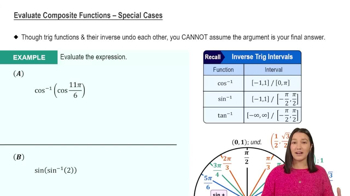
Evaluate Composite Functions - Special Cases

Function Notation

Function notation is a way to represent functions and their relationships. In this context, h(x) represents the output of the function h for a given input x. Recognizing how to manipulate and interpret function notation is crucial for identifying the inner and outer functions in a composite function.
Recommended video:
7:24
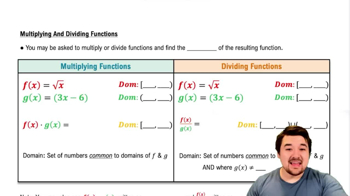
Multiplying & Dividing Functions

Power Functions

Power functions are functions of the form f(x) = x^n, where n is a real number. In the given function h(x) = (x³ - 5)¹⁰, the outer function can be identified as a power function, while the inner function can be the expression inside the parentheses. Understanding power functions helps in determining how to break down the composite function into its components.
Recommended video:
04:02
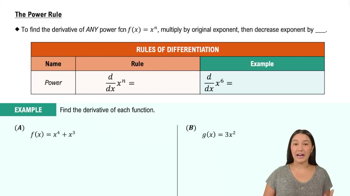
The Power Rule