Find the inverse of each function (on the given interval, if specified).
Ch. 1 - Functions
Briggs3rd EditionCalculus: Early TranscendentalsISBN: 9780136847243Not the one you use?Change textbook
Chapter 1, Problem 1.R.44
Solving equations Solve each equation.
ln 3x + ln (x + 2) = 0
Verified step by step guidance1
Combine the logarithms on the left side using the property \( \ln a + \ln b = \ln(ab) \).
This gives us \( \ln(3x(x + 2)) = 0 \).
Exponentiate both sides to eliminate the natural logarithm, using the property that if \( \ln(a) = b \), then \( a = e^b \).
This results in \( 3x(x + 2) = e^0 \), which simplifies to \( 3x(x + 2) = 1 \).
Expand and solve the quadratic equation \( 3x^2 + 6x - 1 = 0 \) using the quadratic formula or factoring, if possible.

Verified video answer for a similar problem:
This video solution was recommended by our tutors as helpful for the problem above.
Video duration:
5mWas this helpful?
Key Concepts
Here are the essential concepts you must grasp in order to answer the question correctly.
Properties of Logarithms
Logarithms have specific properties that simplify their manipulation. For instance, the product property states that ln(a) + ln(b) = ln(ab). This property allows us to combine logarithmic expressions, which is essential for solving equations involving logarithms.
Recommended video:
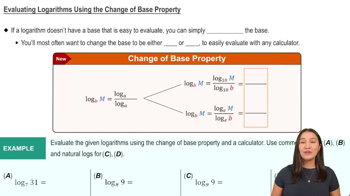
Change of Base Property
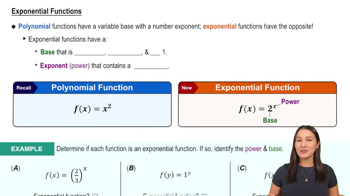
Exponential Functions
Exponential functions are the inverse of logarithmic functions. When solving logarithmic equations, converting the logarithmic form to its exponential form is often necessary. For example, if ln(y) = x, then y = e^x, which helps isolate the variable in the equation.
Recommended video:
Exponential Functions
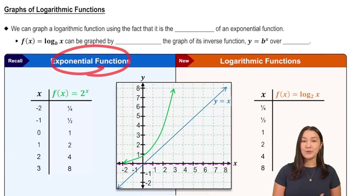
Domain of Logarithmic Functions
The domain of a logarithmic function is restricted to positive real numbers. This means that the arguments of logarithms must be greater than zero. Understanding this concept is crucial when solving logarithmic equations, as it ensures that the solutions found are valid within the context of the logarithmic function.
Recommended video:
Graphs of Logarithmic Functions
Related Practice
Textbook Question
370
views
Textbook Question
Assume f is an odd function and that both f and g are one-to-one. Use the (incomplete) graph of f and the graph of g to find the following function values. <IMAGE>
f⁻¹( g⁻¹(4))
249
views
Textbook Question
Assume f is an odd function and that both f and g are one-to-one. Use the (incomplete) graph of f and the graph of g to find the following function values. <IMAGE>
f⁻¹ (10)
238
views
Textbook Question
Assume f is an odd function and that both f and g are one-to-one. Use the (incomplete) graph of f and the graph of g to find the following function values. <IMAGE>
f-1(1 + f(-3))
215
views
Textbook Question
Evaluate and simplify the difference quotients (f(x + h) - f(x)) / h and (f(x) - f(a)) / (x - a) for each function.
f(x) = x2 - 2x
621
views
Textbook Question
Defining piecewise functions Write a definition of the function whose graph is given <IMAGE>
452
views